HVAC No Dispatcher? How to Keep Every Lead Warm for $99/Month
It's a Tuesday in July. You're in an attic. 130 degrees, insulation in your teeth, sweat soaking through your shirt. Your phone rings. You can't get to it. Three rings, then silence. No voicemail.
By the time you climb down 45 minutes later, that caller is already booked with the shop that picked up.
That's not a bad day. For most HVAC shops running without a dispatcher, that's just Tuesday.
Quick Summary
- • Running 1–3 trucks without a dispatcher is the right call at your revenue stage, not a gap in your business
- • A full-time dispatcher costs $45K–$62K/year; the industry benchmark for hiring one is ~$3M in revenue
- • The one dispatcher function that matters now: keeping inbound leads warm while you're on a job
- • A 30-second auto-text does exactly that for $99/month
- • Setup takes about 20 minutes. No new number, no app for your customers
In This Post
- 1. The No-Dispatcher Reality
- 2. What a Dispatcher Actually Does (and the One Part That Matters to You)
- 3. What a Real Dispatcher Costs (and When It Makes Sense)
- 4. What Happens in the 10 Minutes After You Miss a Call
- 5. How an Auto-Text Does the Dispatcher's Most Important Job
- 6. The Math: $99/Month vs. $47K+/Year
- 7. Setting This Up in 20 Minutes
The No-Dispatcher Reality
Most 1–3 truck shops run like this: the owner is in the field, the tech is in the field, and the phone situation is whatever it is. Maybe a spouse handles it between everything else they're doing. Maybe there's a part-timer who answers calls a few hours a day. Most of the time, especially during peak season, calls land in voicemail.
That's not a failure. It's just the reality of running lean. You can't be elbow-deep in a condenser and on the phone at the same time.
Chicago shops feel this particularly hard. The first hot week of summer (usually late June) is when temperatures push into the 90s and every 1970s Bungalow Belt AC decides to quit at once. Call volume triples overnight. I've talked to 2-truck Chicago shop owners who were booked six jobs deep before 9am during that stretch. The phone never stops. Most of those calls go to voicemail. A lot of those jobs go to whoever didn't. For what to expect when that week hits, this post on Chicago's first hot week call surge lays it out.
The no-dispatcher problem isn't Chicago-specific. It's every small HVAC shop in the country. But in a city with 2,600+ licensed contractors, the gap between missing a call and losing the job is measured in minutes, not days.
What a Dispatcher Actually Does (and the One Part That Matters to You)
At a 10–15 truck operation, a dispatcher earns every dollar. They're coordinating routes, matching technicians to jobs by skill, debriefing techs after each call, flagging estimates that never got a follow-up, making sure the zero-dollar tickets don't fall through. Good dispatchers are hard to replace at that scale.
But that's not your situation.
At 1–3 trucks, you already know what's on the board. You know which jobs need your hands versus your tech's. You don't need route optimization or skill-matching. You're running all of that in your head, and it works.
The one dispatcher function that does apply to you: being available to answer the phone and tell an inbound caller "yes, we're here, someone will call you back." That's it. At scale, a dispatcher handles a dozen things. At your stage, you need them to handle one thing: keeping a new lead from hanging up and calling the next shop on Google.
Owned and Operated, which covers operations for trades businesses as well as anyone, puts the dispatcher hire threshold at around $3M in annual revenue. That's the right call. All the other dispatcher functions start making economic sense at that scale. The single function of holding inbound leads? You need that now.
What a Real Dispatcher Costs (and When It Makes Sense)
Just numbers. No softening.
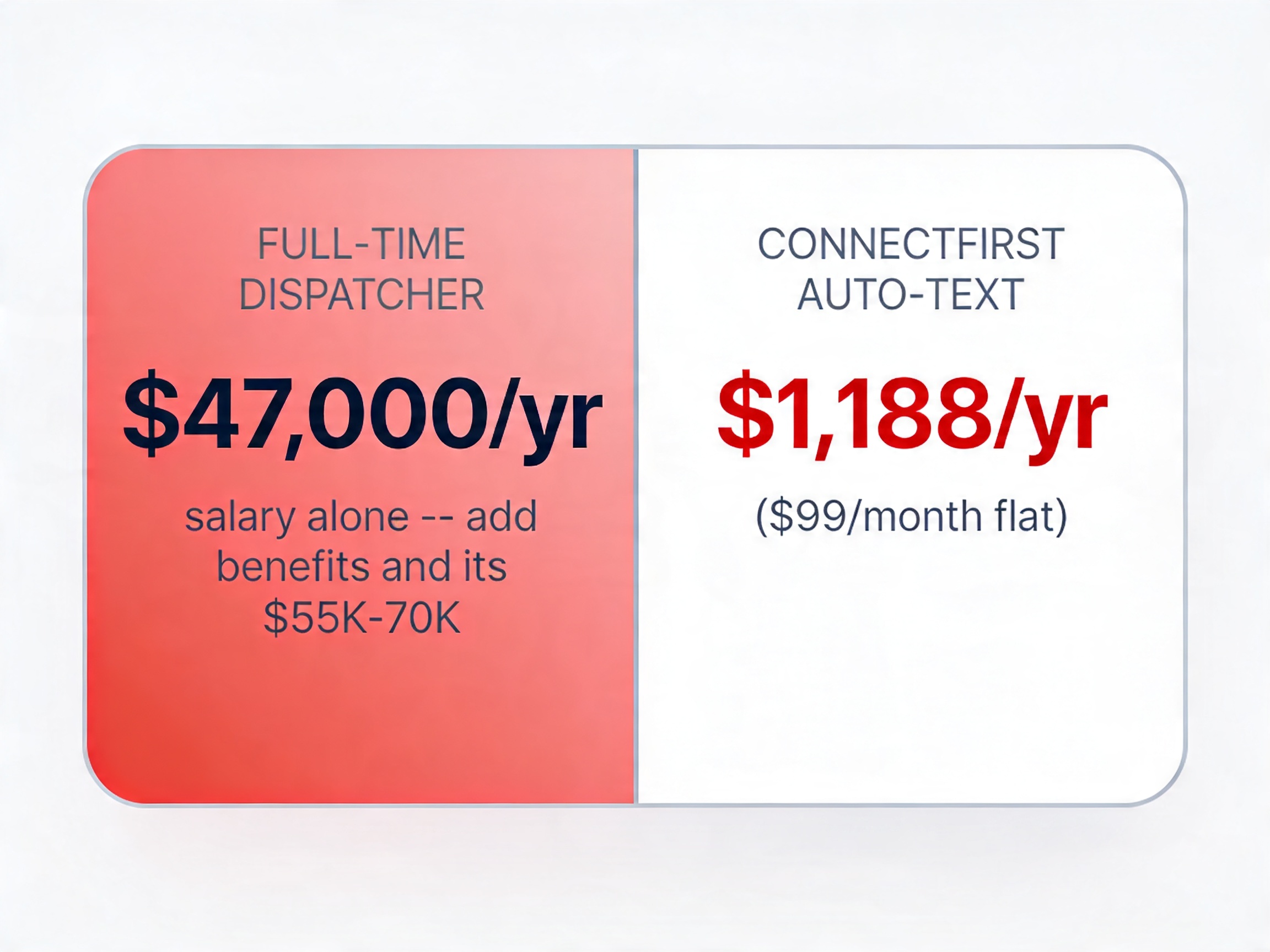
The average HVAC dispatcher earns $45,823 per year according to ZipRecruiter. Add employer taxes, health benefits, and onboarding and the real first-year cost lands closer to $55,000–$70,000.
A 2-truck shop running 200 jobs at a $3,200 average is doing roughly $640,000 in revenue. Three trucks, 300 jobs: around $960,000. Even at the top of that range, you're not at $3M. A full-time dispatcher doesn't pencil out yet, and that's not a knock on your operation. It's just where the breakeven is.
What Happens in the 10 Minutes After You Miss a Call
Here's the sequence, reconstructed from what operators tell me and what the data shows:
- A homeowner calls you. Nobody picks up. They hang up. No voicemail.
- They go back to Google and click the next result.
- That shop texts back in 30 seconds, or a human picks up.
- They book the job.
The numbers that make this concrete:
- 62% of callers won't leave a voicemail. They hang up and move on.
- 78% of customers go with whoever responds first. Not the best price. Not the most reviews. Whoever responded.
- 85% of missed callers never call back at all.
- At an average HVAC job value of ~$3,200, five missed calls a week during a 16-week peak season, at even a 30% booking rate if you'd responded, is roughly $24,000 gone.
You can run your own numbers with ConnectFirst's missed-call calculator. Most shop owners come out higher than they expected.
Instant Sales Funnels puts the average monthly cost of missed calls for HVAC contractors at $3,800. I can't confirm that holds for every shop, but the direction is right. During peak season, each missed call is a real job walking to someone else.
In a dense market like Chicago, with 2,600+ licensed contractors, "the next guy" is literally three search results away.
How an Auto-Text Does the Dispatcher's Most Important Job
Remember that one dispatcher function that matters at your stage: answering "are you available?" before the caller hangs up and dials someone else.
A missed-call auto-text does exactly that.
When you miss a call, the text goes out within 30 seconds, from your business number, with your shop name, in plain language:
"Hey, this is [Shop Name]. Saw you just called. We're with a customer right now but will get back to you within a couple of hours. Reply here if you want to tell us what's going on."
The caller got a response. They're not sitting in silence wondering if you're even a real business. They're waiting for you. By the time you climb down and check your phone, the thread is sitting there, warm and waiting instead of gone.
You pick up the conversation and close it from there. This isn't a hands-off intake system. It's the text that buys you the 90 minutes you need to finish the job you're already on.
For a deeper look at how the text-back mechanic works (templates, timing, what to say), this post on HVAC missed-call text-back covers it in detail. And once the lead replies and you're ready to close, HVAC lead follow-up walks through how to convert that thread into a booked job.
Pro Tip
Personalize the template with your shop name and a real reply window. "Within a couple of hours" is honest and specific. "We'll be in touch soon" reads like an autoresponder and gets fewer replies. Operators tell us this consistently.
The Math: $99/Month vs. $47K+/Year
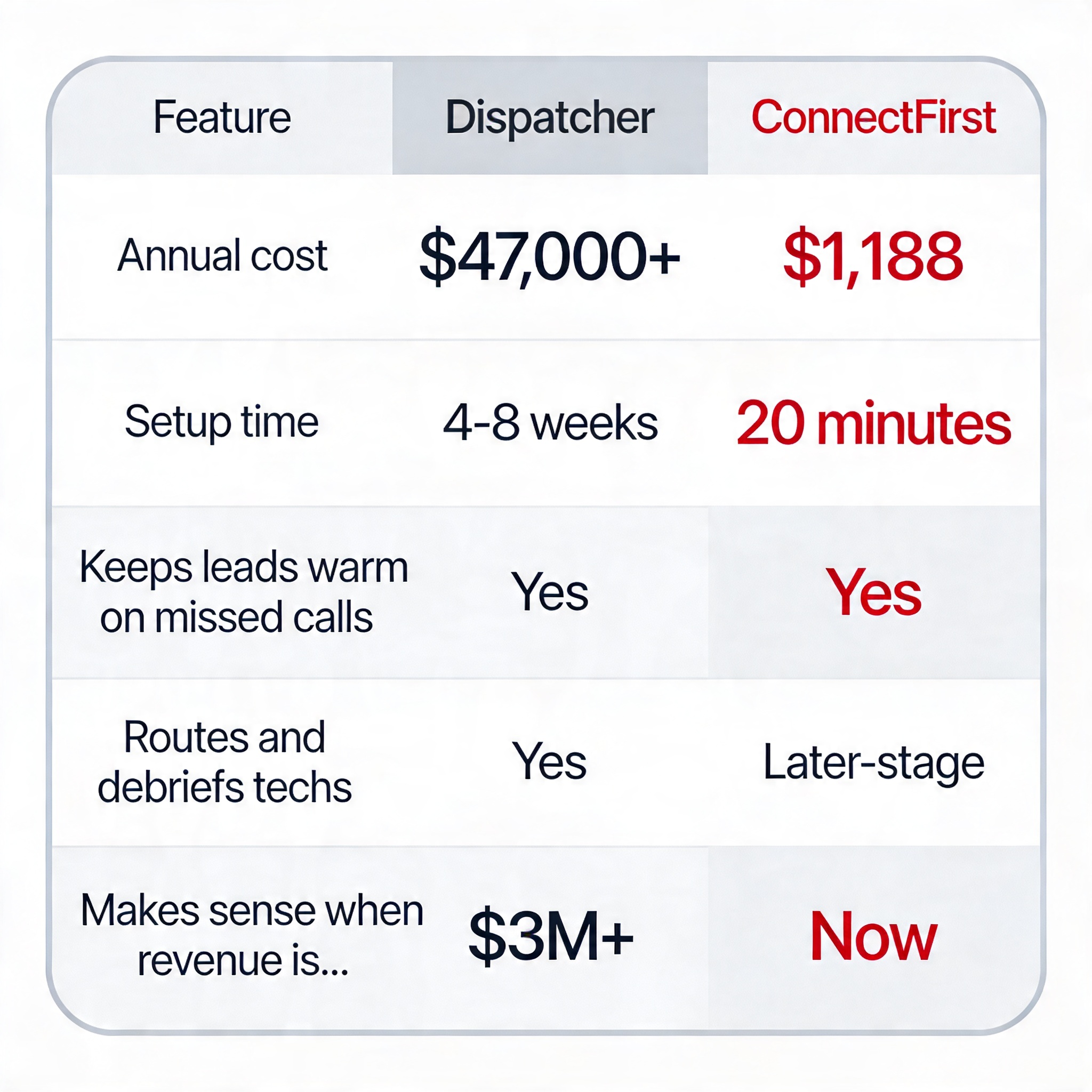
| Full-Time Dispatcher | ConnectFirst Auto-Text | |
|---|---|---|
| Annual cost | $47,000–$70,000+ | $1,188 |
| Setup time | 4–8 weeks | 20 minutes |
| Keeps inbound leads warm while you're on a job | Yes | Yes |
| Routes, skill-matches, debriefs techs | Yes | That's a later-stage problem |
| Makes sense when annual revenue is... | ~$3M+ | Now |
ConnectFirst runs $99/month flat. Twilio SMS pass-through adds about $3–8/month. That's under $110/month all-in, less than a tank of diesel a week.
One recovered job per month covers the full annual cost. Most shops recover more than one.
Your calls are covered while you're on the job.
ConnectFirst texts back every missed caller within 30 seconds, from your number, with your name on it. Setup takes about 20 minutes. No new number. No app for your customers.
See It Live
Setting This Up in 20 Minutes
No new phone number. Your customers don't download anything. Here's how it goes:
- Connect your existing business number. ConnectFirst works with your current number: your cell, a tracking number, or Google Voice.
- Write your auto-text template. One message, your shop name, an honest reply window. Takes five minutes to get right. You can change it any time.
- Test it with a real call. Dial your own number, let it ring out, confirm the text arrives on your other phone. That's the whole test.
- Get back to work. Every missed call now gets a response in under 30 seconds. You finish the job. The lead waits.
Nothing your customer needs to know about or install. Nothing your tech has to manage. The phone problem that's been costing you jobs every peak season gets covered in the time it takes to eat lunch.
Key Takeaways
- Running 1–3 trucks without a dispatcher isn't a business problem. It's the right call at your current revenue stage.
- A full-time dispatcher costs $45K–$70K/year all-in. The industry benchmark for hiring one is around $3M in revenue. Most small shops aren't there, and shouldn't be yet.
- The one dispatcher function that matters at your stage: keeping inbound leads from going cold while you're on a job.
- 62% of callers won't leave a voicemail. 78% go with whoever responds first. 85% never call back. At $3,200 average job revenue, the cost of inaction adds up fast.
- A 30-second auto-text holds the lead until you can get back to them, for $99/month.
- Setup takes 20 minutes. One recovered job per month covers the full annual cost.
ConnectFirst
Missed-call text-back for small HVAC shops. $99/month flat. Setup in 20 minutes.