It’s the first Monday after Chicago finally snaps into real heat. Your phone started buzzing at 6:45am. By 9am you’ve got a page of voicemails. Both trucks are already on jobs. You’re under a bungalow in Portage Park checking a frozen coil, and the AC repair calls keep lighting up the line anyway.
That week is not “busy season” in the abstract. It’s the Chicago HVAC first hot week moment — when homeowners who’ve been fine through a cool spring all try their cooling at once, and a chunk of those systems fail under the first serious load.
If you run a 1–5 truck residential shop in the Chicago metro, this guide is the operator’s version of that story: what’s different about this city, where the demand actually comes from, what Chicago HVAC call volume can feel like when it doubles or triples, and what to do before it hits.
The short version
- Chicago’s first sustained 90°F+ stretch often lands around early June on average — but the exact week moves year to year, and that unpredictability is the hard part
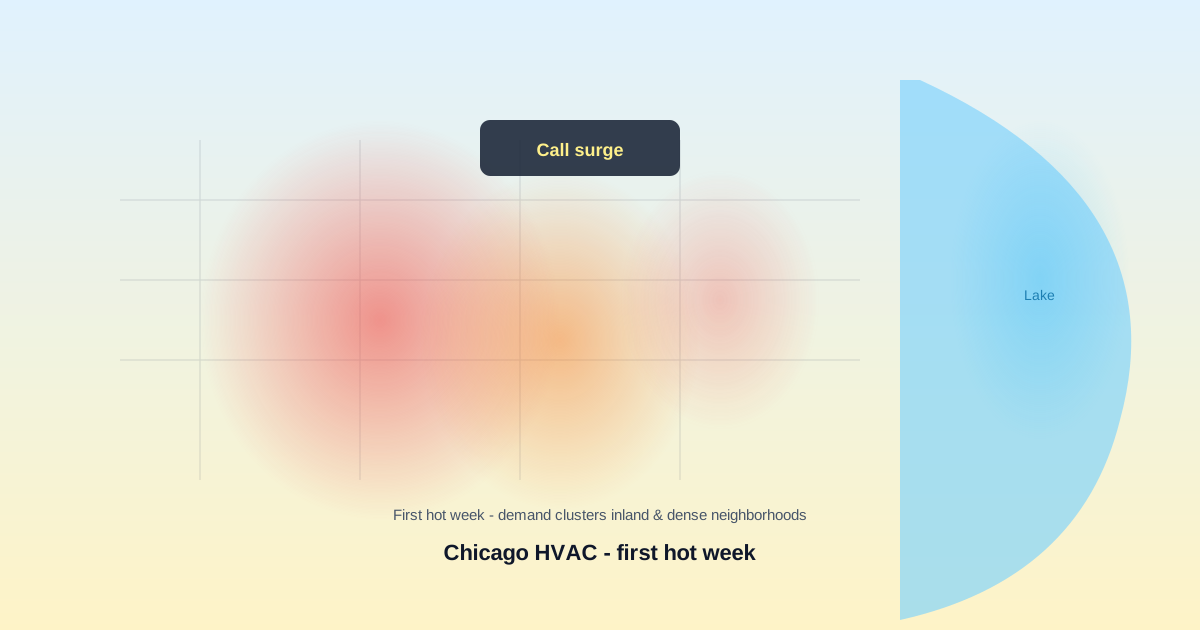
- Lake Michigan keeps some lakefront neighborhoods cooler than inland blocks; the first hot week doesn’t hit every zip code evenly
- Older housing types (bungalow belt, greystones, 2–4 units) produce different emergency patterns than newer suburban central AC
- Industry patterns show big surges around seasonal transitions; small shops feel that as voicemail pileups and missed high-intent calls
- Prep beats panic: parts on trucks, realistic phone coverage, and a fast text-back when nobody can pick up
In this article
Why the Chicago HVAC First Hot Week Breaks Your Normal Call Volume
Here’s the part that national “busy season” articles get wrong about Chicago: the Chicago HVAC busy season doesn’t ramp up evenly. A lot of cooling equipment sits idle through a long heating-heavy stretch. The first time it has to carry a real load, marginal stuff fails fast.
The National Weather Service publishes 90°F statistics for Chicago. In the 1981–2010 normals table on that page, Chicago’s normal first date hitting 90°F is June 5 — not a promise for any given year, just a baseline. The same table shows how wild the calendar can get: the earliest first-90°F can land in April, and the latest can land deep in summer. That’s the staffing problem in one sentence: you know heat is coming, but you don’t get to pick the week.
Some years run hot early; other years stay mild deep into June. I’ve watched shops staff like “summer starts Memorial Day” and get caught flat-footed in a cool May — then slammed two weeks later when the forecast finally breaks. The unpredictability is the point.
Lake Michigan matters for how the city feels. Near-lake areas (think Rogers Park, Edgewater, Lincoln Park, Hyde Park on the right day) can run cooler than inland neighborhoods during onshore flow. Swing inland — Belmont Cragin, Austin, Back of the Yards, Gage Park — and the same regional heat day can feel more brutal, especially with concrete, brick, and thinner tree canopy in some corridors. You’ll see that in who calls first, and how desperate the tone is.
Then there’s the equipment reality. Plenty of Chicago housing wasn’t built around central AC at all. Even where central exists, it’s often retrofitted onto older layouts. Capacitors that were “fine” yesterday quit under load today. Contactors stick. Refrigerant issues show up the first time the system actually has to work.
That’s why transition weeks hurt: it’s not just “hot.” It’s first serious load meets old stock meets everyone calling at once.
Industry writeups on seasonal patterns describe the same basic shape: the dangerous surges often cluster around seasonal transitions — the first serious heat after mild weather — when demand jumps far above what a shoulder-season staffing plan can handle. One seasonal breakdown describes summer peak call volume running multiple times baseline and calls out transition spikes as especially risky if you’re still staffed like it’s spring (CallJolt on HVAC call volume by season).
If you want the “before” picture, our spring guide walks through booking tune-ups and shoulder-season marketing while you still have capacity: Chicago HVAC spring tune-up marketing.
Where the Calls Come From: Chicago’s AC Emergency Map
Chicago AC emergency calls don’t all sound the same. They come from different building types — and the job value follows the problem.
Bungalow Belt (northwest, west, southwest, south): Portage Park, Jefferson Park, Belmont Cragin, Marquette Park, West Lawn, Gage Park, Bridgeport, Beverly, Morgan Park — the Chicago Bungalow Association tracks tens of thousands of these homes. Common story: “It won’t come on,” or “It ran for twenty minutes and quit.” You’re often dealing with older duct paths, attic runs that cook on the first hot day, or window units that held on until they didn’t.
Greystone and vintage multi-unit corridors: Lincoln Square, Logan Square, Pilsen, Wicker Park, West Town, Ukrainian Village. One landlord call can represent multiple households unhappy at once. You’re also more likely to get “property manager / tenant” phone-tag — which makes response time matter even more.
Two- to four-unit dense areas: In places like Little Village and Brighton Park, a large share of units sit in 2–4 unit buildings (Institute for Housing Studies on Chicago’s 2–4 unit stock). Owner-occupied plus renters can mean two motivated callers pushing for the same ticket.
High-call-volume pockets: Humboldt Park, Austin, Englewood, Back of the Yards, Woodlawn, South Shore, Chatham, Auburn Gresham — often older housing, tighter budgets, and more “no cool” emergencies where speed matters.
Higher-budget older-home pockets: Lincoln Park, Lakeview, North Center, Roscoe Village, Ravenswood, Edison Park, Norwood Park, Beverly, Hyde Park — you may see more quote requests for replacement once the first heat exposes a dying system.
Suburban ring: Oak Park, Evanston, Berwyn, Cicero, Skokie, Niles, Orland Park, Tinley Park — central AC is common, but a 10–20 year old system on the first hot stretch often presents as “running but not cooling” instead of “dead silent.” Different triage, still a full schedule.
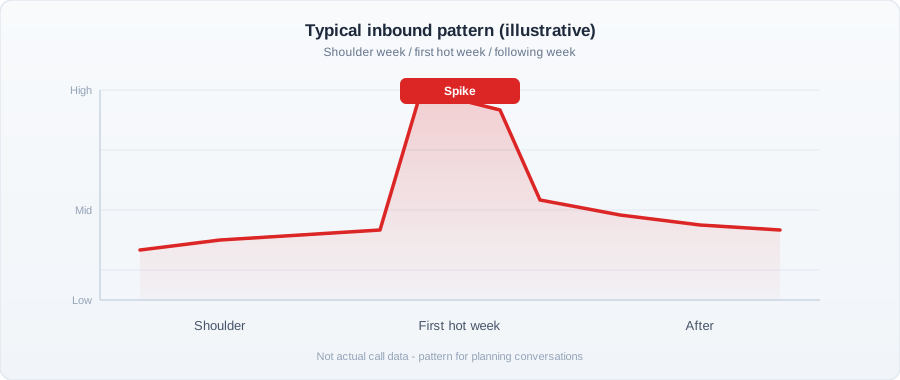
Not your shop’s actual call data — a simple pattern sketch for planning conversations with your team.
Chicago HVAC Call Volume: The Monday Morning Math
Pick a simple model: a three-truck residential shop on a normal late-spring week might be used to a handful of inbound calls a day (mix of booking, price shoppers, and true emergencies). During the Chicago HVAC first hot week, it’s not weird for shops to feel like they’re running 2–3× that inbound load — sometimes concentrated into morning and early afternoon when people notice the house isn’t recovering.
That’s when the office becomes the bottleneck. Techs aren’t ignoring the phone because they don’t care. They’re in attics, on roofs, and in basements. Dispatch is juggling callbacks. Customers are calling multiple companies.
Now add the missed-call math. In call-tracking research focused on HVAC PPC, WhatConverts reports that 27% of calls to HVAC businesses go unanswered — and that’s an average across contexts, not “worst day in July.” Surge weeks are usually worse.
I’m not going to pretend every missed call is a $7,000 install. It isn’t. But a Chicago AC repair emergency during heat is also not a $79 coupon visit. For math you can actually use in your head:
- Service / repair ticket: often roughly $150–$350 for many residential calls (market-dependent).
- Bigger repair / replacement conversations: a few thousand to mid-four figures isn’t a crazy range when the system is cooked and the homeowner is done band-aiding.
So if surge week adds 10 extra real opportunities you would’ve booked, and you miss half because nobody could pick up, you don’t need a spreadsheet to feel the pain — that’s real money walking to the next name on Google.
For more on how fast response times shift outcomes when demand is high, read speed-to-lead for HVAC.
Surge week is when missed calls hurt most
ConnectFirst texts missed callers back in about 30 seconds from your existing business number so you don’t lose the emergency to voicemail roulette. If you want the details, start at the contact form.
Get the short version →What to Do Before Chicago’s First Hot Week Hits
You won’t perfectly “staff” a 3× spike forever. You can make the first hot week less stupid.
1) Build a surge-week schedule on purpose. Extend answering coverage if you can — even an hour earlier — because a lot of “it’s hot” panic shows up early. If you’re owner-dispatching, decide ahead of time what gets a same-day slot vs. a callback.
2) Load the trucks for first-hot-week failures. Capacitors, contactors, common OEM parts you see weekly — this is not the week to run empty because “the supply house is close.” It will be slammed too.
3) Don’t rely on “we’ll call them back tonight.” Callbacks matter, but heat emergencies are time-competitive. If your system can’t pick up, have a plan that still reaches the customer fast (see below).
4) Re-activate your customer list now. Shoulder-season marketing is perishable. If you still have tune-up capacity, say so. Cross-link reminder: spring tune-up marketing in Chicago.
5) Post on Google Business Profile with neighborhood language. Chicago searches are hyper-local. Name the areas you actually serve — it helps humans and it reminds your team where demand clusters.
6) Set expectations in the greeting. If you’re slammed, a clear message beats silent holds and mystery voicemail. People still shop around — but you reduce the “they don’t even pick up” one-star moments.
7) Rotate who covers the phone. If one person always catches overflow, they burn out. If you’re a two-tech owner-operator, even a simple rule (“first missed call of the day gets a text template”) helps.
The Calls You Miss During a Chicago AC Emergency
This is the part that stings: the calls you miss during a Chicago AC emergency are often the highest-intent calls you’ll get all year. Somebody’s uncomfortable, sometimes unsafe-hot, and they’re working down the Google list fast.
We’ve written about the mechanics behind missed calls in trades — it’s usually not negligence, it’s capacity and field work: why HVAC businesses miss calls.
The fix isn’t “try harder.” It’s a system: something that engages the caller even when you can’t pick up. That’s the whole idea behind missed-call text-back: an automatic SMS that hits fast enough that the customer doesn’t immediately dial the next shop. Walkthrough here: HVAC missed call text-back.
If you want to talk about whether it fits your shop, hit the contact page.
Key Takeaways
- Chicago’s first hot week is a transition event, not a smooth ramp. NWS normals give a baseline for first 90°F timing, but the exact week varies year to year.
- Lake vs. inland and neighborhood context change how heat lands — and who calls first.
- Housing stock drives call type: bungalows vs. greystones vs. 2–4 units vs. suburban central each produce different emergencies and tickets.
- Call volume can spike multiples over shoulder season during the first serious heat — your phone system breaks before your techs “get lazy.”
- Missed calls during surge are expensive because the intent is high; industry call data shows a big share of calls never turn into a conversation when shops can’t answer.
- Prep: stock, scheduling realism, GBP messaging, and a fast customer touch when calls overflow.
ConnectFirst is missed-call text-back automation for small HVAC businesses. When a call goes unanswered, ConnectFirst texts the caller back in about 30 seconds from your existing business number, before they dial the next shop on the list. Learn more at connectfirst.today.