It's a Tuesday in June. Your tech is in a tight attic. Hands full, it's 97 degrees up there, and he's not answering anything. Your cell rings. Goes to voicemail. Twenty-five minutes later, back in the truck, you check: missed call, no message. You call back. "Oh, I already found someone else."
That's a $500 service call. Maybe a $6,000 replacement conversation. Gone.
If you run 1–5 trucks, this isn't a rare bad day. It's Tuesday. And Wednesday. And every day during peak season when your phones are ringing fastest and your people are least able to answer them. The good news: this specific problem has a fix that costs less per month than a tank of diesel and takes about 10 minutes to set up. That fix is called HVAC missed call text back.
Quick summary
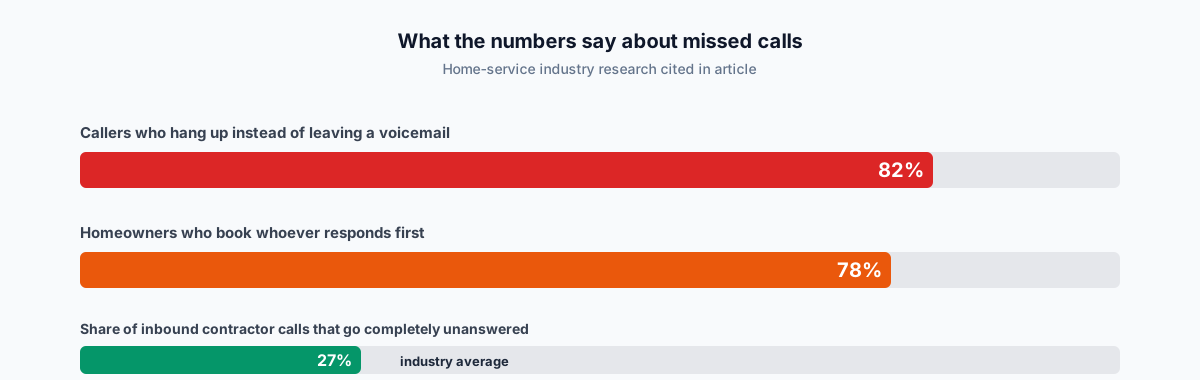
- 80–85% of HVAC callers who hit voicemail call the next business instead. They won't wait for a callback.
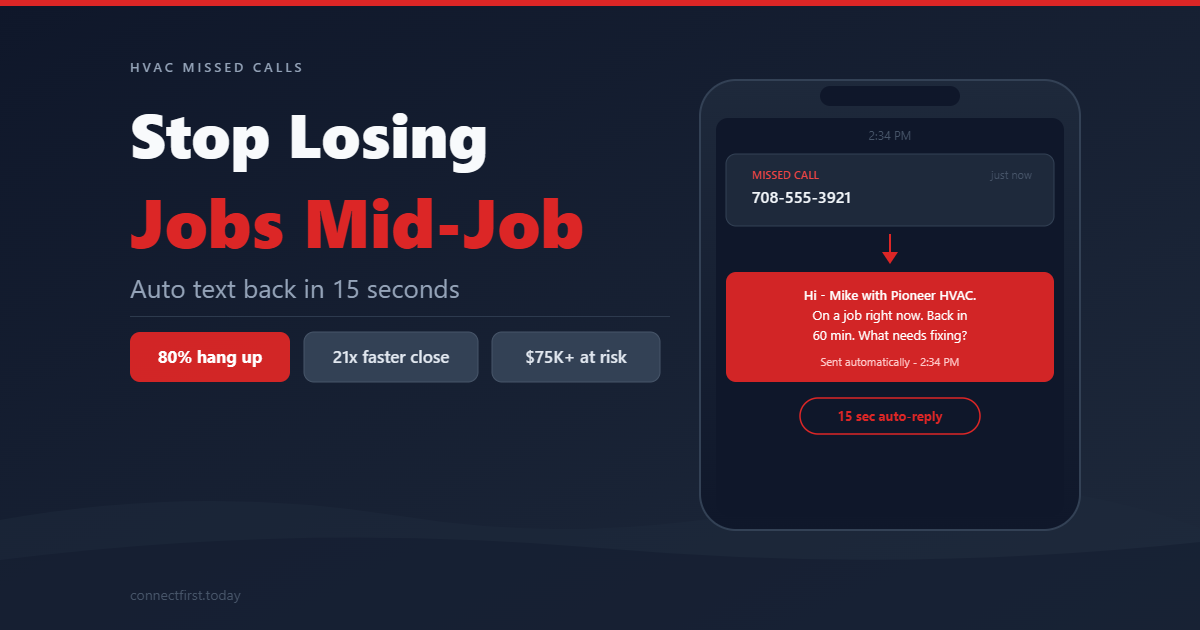
- A missed call text-back fires an automatic reply to the caller within ~15 seconds, keeping the lead warm while you finish the job
- For a 3-truck shop, unaddressed missed calls can represent $75,000+ in lost annual revenue
- Text-back tools run $20–$97/month vs. $125–$350/month for a live answering service
- Setup takes under 10 minutes and works with your existing phone number
For the full picture on what missed calls cost and why voicemail fails, read why HVAC businesses miss so many calls.
In this article
Why HVAC Contractors Miss So Many Calls
You're not missing calls because you're bad at running a business. You're missing them because your business is working. Your techs are in crawlspaces and attics. You're ordering parts, doing estimates, dispatching the next job. Nobody's sitting at a desk waiting for the phone to ring.
Industry data backs this up: about 27% of inbound home-service calls go completely unanswered. Not dropped, not forwarded to voicemail after one ring. Completely unanswered. For a busy 3-truck shop during A/C season, that's not a surprise. It's physics.
Over on ContractorTalk, one HVAC owner put it plainly: "I missed 12 calls last Tuesday. Booked solid all day. Could have been 3–4 extra jobs." That's the exact tension: a full schedule means maximum missed calls. The busiest weeks are the weeks you lose the most leads.
The real problem isn't that you miss calls. It's what happens next. The old assumption ("if they really need us, they'll call back or leave a message") stopped being true around 2018. Homeowners don't leave voicemails. They call the next HVAC company on Google, and they book whoever answers first.
You've got maybe a 15–30 minute window before a missed-call lead is gone. And that window is tightest exactly when you're most slammed.
What Happens When a Call Goes to Voicemail (The Math)
Here's the stat that should bother you: 80–85% of callers who reach voicemail do not leave a message and instead call the next business. Not most. Not a lot. Eighty to eighty-five percent.
That's from SkipCalls' research on home service businesses, and it matches what every HVAC owner I've talked to reports anecdotally. Customers don't wait. They Google "HVAC near me," they call down the list, and they book whoever picks up.
Speed matters more than you'd think. Research from MIT and InsideSales found that responding within 5 minutes makes you 21 times more likely to convert a lead than if you respond after 30 minutes. Not 21% more likely — 21 times. The drop-off in lead quality is almost a cliff. The numbers by minute are in post on HVAC lead response time.
Now run the math for a real 3-truck operation:
| Weekly | Monthly | Annual | |
|---|---|---|---|
| Inbound calls | ~15 | ~60 | ~750 |
| Calls missed (est. 25–30%) | ~4 | ~16 | ~200 |
| Callers who call the next business (80%) | ~3 | ~13 | ~160 |
| Lost at avg. $500/ticket (60% connect, 33% close) | ~$300 | ~$1,300 | ~$16,000 |
| Lost if 20% of missed calls are replacements ($6,000 avg.) | ~$1,200 | ~$5,100 | ~$60,000+ |
The conservative number, service calls only, is $16,000/year. Add the replacement scenarios that concentrate during peak season and you're looking at $60,000–$100,000 walking out the door annually because the phone rang at the wrong moment.
Cross-industry research from Phone2.io puts average annual missed-call losses for small businesses at $126,000. For HVAC, with high ticket values and intense seasonal demand, your exposure is real.
What Is HVAC Missed Call Text Back and How Does It Work?
When a call comes in and nobody answers, the caller hits voicemail. Eighty percent of them hang up and move on. HVAC missed call text back interrupts that pattern.
Here's what happens instead:
- Call comes in. Nobody picks up.
- Within ~15 seconds, the caller gets a text message from your business number.
- The message acknowledges the call, tells them you'll be in touch shortly, and invites them to reply with details about what they need.
- The lead stays warm. They're texting you instead of Googling your competitors.
That 15-second window is everything. The caller is still holding their phone. They just tried to reach you. An immediate text back says "we saw you, we're not ignoring you, someone will be with you soon." That's enough to keep most people from dialing the next number on Google.
It works with your existing phone number (cell, landline, or VoIP). You don't need new hardware. Your techs don't need to learn a new app. The only thing that changes is that missed calls now get an automatic reply instead of silence.
The platform monitors your incoming calls in the background. When a call goes unanswered past a set number of rings, the auto-text fires. Some platforms also let you customize the message by time of day (business hours vs. after-hours), which matters a lot for HVAC where emergency calls happen at 10pm.
Voicemail requires the caller to leave a message, you to listen to it, and then call back. That sequence typically takes 15–30 minutes. By then, the window is closed. Automatic text reply for missed calls short-circuits that whole chain.
For the legal and compliance side of automated replies, see how auto text-back works (and why it's legal).
The Seasonal Stakes: When a Missed Call Could Be Worth $6,000
Not all missed calls are created equal.
A missed call in mid-October, when demand is low and you're doing tune-ups and maintenance, might cost you a $350 job. Frustrating, but not catastrophic.
A missed call during the third week of June, when the heat index is 105 and every aging A/C unit in your service area is pushing past its limits, is a different situation entirely. That call could be a homeowner whose 17-year-old Carrier just died. That's a $5,000–$8,000 replacement job. Miss it, and the company that answers gets the sale and a repeat customer for the next 15 years.
Average HVAC service ticket: $300–$800. System replacement: $4,000–$10,000. The math isn't evenly distributed across the calendar.
June through August (cooling season) and December through January (heating season) are when call volume and ticket value spike at the same time. Industry estimates suggest that roughly 40–50% of annual revenue exposure from missed calls concentrates in those 8 weeks. One bad week during a heat wave (15 calls, 5 missed, 2 of them replacement leads) can represent $10,000–$15,000 in lost work.
There's a compounding effect too: a homeowner who can't reach you in a heat emergency doesn't try again. They find someone who answered. And they tell their neighbors about it.
Text-back won't recover every lost lead. But it keeps you in the conversation long enough to close the ones that matter most: the big jobs that land during your busiest, most chaotic weeks.
What to Say: A Copy-Paste Text-Back Message for HVAC
The message itself matters. "We missed your call. We'll call you back soon." is technically a reply. It's also forgettable and doesn't invite any response. You want something that keeps the conversation going.
Here's what works for HVAC specifically: personal enough to feel human, brief enough to read at a glance, and open-ended enough to get a response.
More examples and wording ideas are in what to say in your missed-call text.
Standard business-hours version:
Hi, this is [First Name] with [Company Name] — sorry I missed your call,
I'm on a service call right now. What's going on with your system?
I'll get back to you within the hour.
After-hours / emergency version:
Hi! [Company Name] here — we got your call. For HVAC emergencies,
reply here or call back and press 1. Otherwise, I'll reach out
first thing tomorrow morning. What can we help with?
A few things to notice about these:
- First name: makes it feel like a real person, not an autoresponder
- "I'm on a service call": explains why you didn't answer without sounding like an excuse. Busy = in-demand. It builds credibility.
- Open-ended question: "What's going on with your system?" gets them typing. Once they type, they're invested and less likely to call someone else.
- Specific timeframe: "within the hour" sets an expectation. Vague promises ("we'll be in touch!") don't hold leads.
You can store different versions in your platform: one for peak season, one for after-hours, one for when you're out of range. The important thing is that something fires within 15 seconds. Don't overthink the copy. A slightly imperfect message that sends automatically beats a perfect message you write by hand 30 minutes too late.
Text-Back vs. Answering Service: The Honest Comparison
I'm not going to tell you answering services are a scam. For some HVAC businesses, they make sense. But for a 1–5 truck operation trying to stop leads from bleeding out, the comparison isn't close.
| Missed Call Text-Back | Live Answering Service | |
|---|---|---|
| Monthly cost | $20–$97 | $125–$350 |
| Response time | ~15 seconds | 60–90 seconds (if they answer) |
| Works after hours | Yes (automated) | Yes (live agent) |
| Can book appointments | No (initiates conversation) | Yes |
| Takes detailed job info | No | Yes |
| Setup time | Under 10 minutes | 1–3 days (scripting, onboarding) |
| Works with existing number | Yes | Sometimes (depends on vendor) |
| Per-minute charges | No | Often yes |
Answering services earn their money in specific scenarios: you need someone to actually book appointments in your scheduling software, or you have significant after-hours emergency volume where a human needs to triage "AC is out" from "my house is flooding." If that's your situation and you're at 4–5 trucks, a live service on top of text-back might be worth it.
But for the core problem (caller hits voicemail, calls the next guy, job is gone), a text-back tool at $20–$97/month solves it better and faster than a $250/month answering service.
Here's a concrete example: one HVAC operator with 50 missed calls per month added text-back and recovered 5–8 extra bookings monthly. At a $400 average ticket, that's $2,000–$3,200 per month recovered. The SMS cost for those auto-replies? Under $1. The service itself? Under $100. The math isn't complicated.
One more thing: owner-operators on ContractorTalk and similar forums consistently say that $200–$300/month for an answering service "feels like a full day's labor" at the 2-truck level. That friction is real. A $50/month tool they can cancel without a phone call lowers the barrier to actually fixing the problem.
How to Set Up HVAC Missed Call Text Back (Under 10 Minutes)
The biggest objection I hear is "sounds complicated." It's not. Here's the actual process:
Step 1: Choose a platform. For small HVAC shops, ConnectFirst is built for missed-call text-back — you won't be wading through features designed for dental offices or law firms.
Step 2: Connect your business phone number. Most platforms connect to your existing cell, landline, or VoIP number. You're not getting a new number. Your customers call the same number they've always called.
Step 3: Write your text-back message. Use the template above or customize it. Keep it under 160 characters for clean SMS delivery. Save it.
Step 4: Set your trigger rules. Decide how many rings before the auto-text fires (most people use 4–5 rings, matching their voicemail threshold). Set different messages for after-hours if you want.
Step 5: Test it. Call your own number from a different phone. Let it ring to voicemail. You should receive a text within 15–20 seconds. If it works, you're live.
Step 6: Go. That's it. Your techs don't need to know anything changed. The system runs in the background. Every missed call now gets a response.
Total time: 8–12 minutes, including testing. No IT help required.
For a step-by-step on getting tracking and text-back live quickly, see missed call text-back setup in 20 minutes.
Stop Losing Leads While You're On Jobs
ConnectFirst fires a text within about 30 seconds of every missed call, from your existing number, with no new hardware. Built for HVAC contractors specifically. See it live →
FAQ
What is missed call text back and how does it work?
Missed call text back is a tool that automatically sends a text message to anyone who calls your business and doesn't get an answer. When a call goes to voicemail, the system detects it and fires a text to the caller's number within about 15 seconds. It keeps the lead engaged while you're busy on a job.
Does missed call text back work for HVAC companies?
Yes, and HVAC is one of the best fits for it. HVAC techs spend most of their day in locations where they can't answer phones (attics, crawlspaces, rooftops). Missed call text back bridges that gap without requiring any change to how your team operates. The auto-reply fires regardless of where your tech is or what they're doing.
How much does missed call text back cost?
Most platforms run $20–$97/month for small businesses. HVAC-specific tools tend to sit in the $49–$97 range with no per-minute or per-message charges beyond standard SMS rates. Compare that to live answering services at $125–$350/month, and text-back is the lower-cost option for most 1–5 truck operations.
What should I say in a missed call text back message?
Keep it personal and brief. Include your name and company, acknowledge you were on a job (which explains the miss and builds credibility), ask an open-ended question about their system, and give a specific callback window. The copy-paste templates above work for both business hours and after-hours scenarios.
Is a missed call text back better than an answering service?
For the specific problem of "caller hits voicemail and calls the next company," text-back wins on speed (15 seconds vs. 60–90 seconds), cost ($20–$97/mo vs. $125–$350/mo), and simplicity. Answering services earn their keep if you need someone to actually book appointments or handle complex after-hours triage. For most 1–5 truck HVAC shops, start with text-back. It solves the core problem at a fraction of the cost.
Can I use missed call text back with my existing phone number?
Yes. You don't need a new number. The platform connects to your existing cell, landline, or VoIP number. Callers dial the same number they always have, and the auto-text goes out from that same number so it looks like a text from you.
How quickly should you respond to a missed call?
Within 5 minutes if at all possible. MIT and InsideSales research found that responding within 5 minutes makes you 21 times more likely to convert a lead versus responding after 30 minutes. The callback window narrows fast. Most homeowners have moved on within 15–30 minutes of hitting voicemail. Automated text-back eliminates the delay entirely by responding in seconds.
Key Takeaways
- 80–85% of HVAC callers who hit voicemail call the next business instead. Waiting for them to try again is not a strategy.
- Responding within 5 minutes makes you 21x more likely to close the job. Speed to respond is the single biggest lever you have.
- A missed call text-back fires within ~15 seconds. That's fast enough to keep the caller from opening a new Google search.
- For a 3-truck shop, unaddressed missed calls can represent $75,000+ in lost annual revenue on service calls alone, more once you factor in replacements.
- Text-back costs $20–$97/month; answering services cost $125–$350/month. For most 1–5 truck operations, text-back solves the core problem at a fraction of the cost.
- Setup takes under 10 minutes with no new hardware and no changes for your techs.
- Peak season is when the stakes are highest. One recovered replacement call during a June heat wave covers 6–12 months of software cost. The math is simple.
ConnectFirst automatically texts missed calls within about 30 seconds — no new phone, no new carrier, nothing changes about how you work. Try the live demo →