You put $500 into Google Ads. Set up the campaign on a Sunday night, picked some keywords that sounded right, figured you'd check back in a couple weeks.
Ten days later, the budget's gone. Two calls came in. One was a wrong number. The other was a guy asking if you service commercial walk-in coolers. You don't.
So where did the money go? And more importantly, where should it actually go?
Here's the real math on what $500/month buys in Google Ads versus organic, and how to decide which makes sense for a 1–3 truck shop right now.
In this article
What $500/month actually buys in Google Ads
Start with the arithmetic.
$500/month is $16.67/day. HVAC keywords average $9.12 per click (PPC Chief, 2026). That's roughly 55 clicks per month.
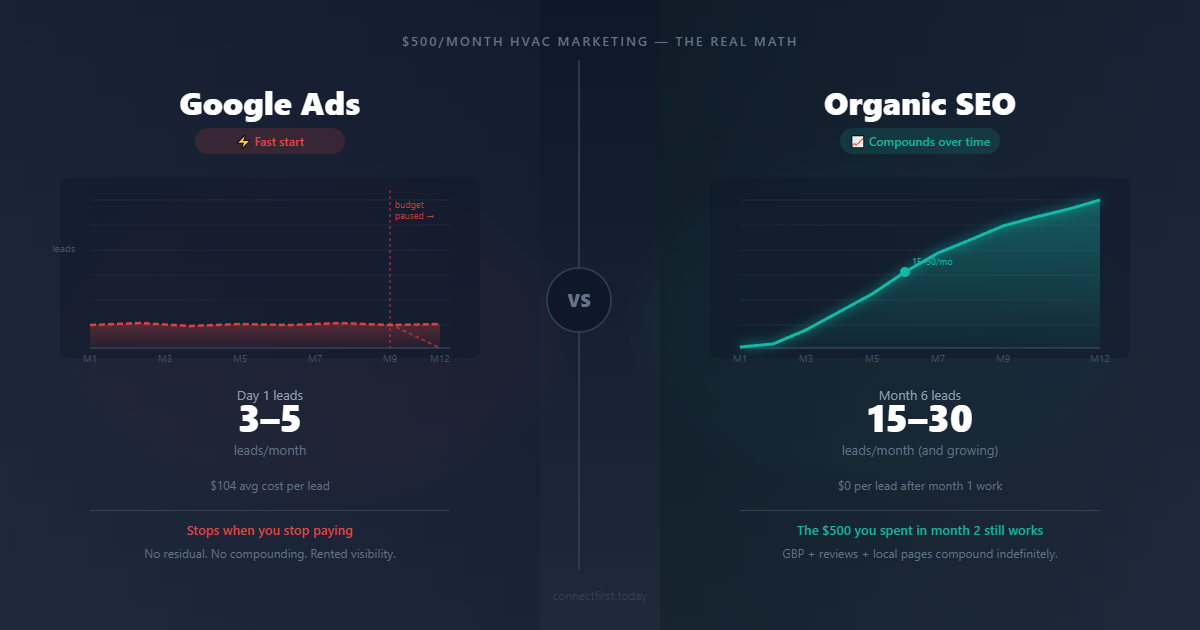
A well-run HVAC campaign converts 5–8% of clicks into leads, so 3 to 4 leads on a good month. SearchLight Digital tracked $14.9 million in HVAC ad spend across 816 contractors and found a blended cost per lead of $104 (January 2026). At $500/month, you're barely covering 5 leads at that rate.
Emergency repair phrases like "AC not working" and "furnace out tonight" run $25 to $45 per click. At $45/click, your $500 budget runs dry after 11 clicks. You haven't gotten to whether those people called, or whether you picked up.
When the budget runs out, the leads stop. No residual, no momentum. You're renting visibility, not building anything.
Why $500 is below the optimization floor
Google Ads gets smarter over time, but that intelligence costs data. The algorithm needs enough booked jobs and call completions before it can find you cheaper leads and better clicks.
At $500/month, you're generating maybe 3–5 leads. That's not enough signal for the machine to learn anything useful. You can't benefit from smart bidding, can't test ad copy, can't let the algorithm do the work that justifies using it.
BuiltRight Digital and RS Gonzales both put the threshold for smart bidding at $1,000–$2,500/month. Below that, you're paying retail rates for leads with no machine learning benefit.
$500/month in Google Ads doesn't mean you're doing half the campaign. It usually means you're doing none of it effectively.
What $500/month buys in organic and your Google Business Profile
This is where $500 actually compounds.
Your Google Business Profile
This costs nothing except a few hours. Make sure every service category is listed correctly. Upload real job photos, not stock images. Answer the Q&A section before customers post bad questions in it. Post an update when you run a seasonal special.
This alone moves rankings for shops that have let their profiles go stale.
Review velocity
RS Gonzales research on local pack rankings points to 3–5 new reviews per week as the threshold separating top-ranked shops from everyone else. Not total reviews. New reviews, consistently arriving.
You don't need a system for this. A text after a job that went well gets results: "Hey, glad we could get that sorted. If you have two minutes, a Google review helps other homeowners find us:" plus your link. If you want to think through what that message should sound like, this piece on missed-call text messaging covers the same principles that apply to any short customer text.
Three reviews a week for eight weeks changes where you show up.
One neighborhood page per month
Not a blog post chasing national rankings. A page about a specific service in a specific area: "Water heater replacement in [your town]." "AC tune-up near [the suburb you drive to twice a week]." Write for a homeowner, not a search engine: real language, real prices if you have them, and real information about what the job involves.
These pages take 3–4 months to rank. Once they do, they send you leads indefinitely.
Citation cleanup
Make sure your name, address, and phone are consistent across Yelp, Angi, HomeAdvisor, your local chamber site, and anywhere else you're listed. Inconsistencies hurt local rankings more than most operators realize.
The timeline:
- Month 1: 0–1 leads. You're building, not harvesting yet.
- Month 3: 5–10 leads/month from GBP and review momentum.
- Month 6: 15–30 leads/month as pages start to rank.
After month 6, those leads cost nothing to maintain. The $500 you put in month 2 is still working.
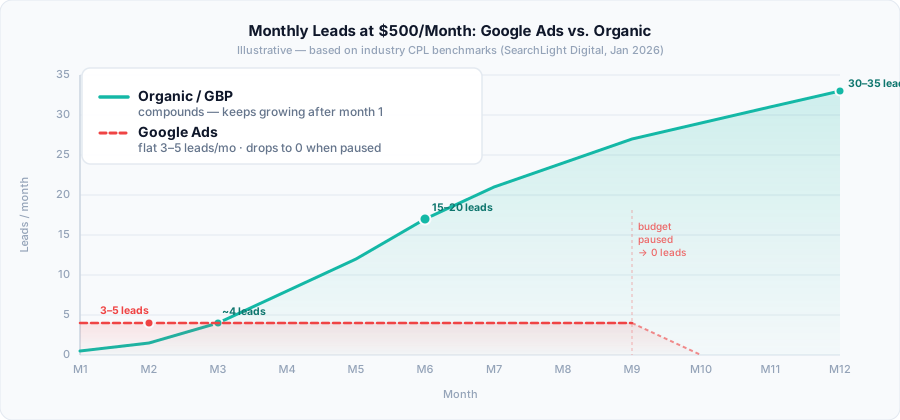
Google Ads delivers leads immediately but resets to zero the moment you pause spend. Organic builds slowly then compounds. The work you do in month 2 is still generating leads in month 12.
Chicago HVAC Google Business Profile: The Marketing Playbook covers the GBP mechanics in detail. The tactics work anywhere, not just Chicago.
If you do run ads, run them smart
Some situations call for paid ads: you're entering a new service area, launching a new service type, or you need revenue in the next 30 days and organic isn't there yet. But at $500/month, keyword selection decides the outcome.
The SearchLight Digital data is specific: AC maintenance keywords average $86 per lead. Water heater replacement keywords average $343 per lead (January 2026). At $500/month, you can target one low-CPL service type. Not two.
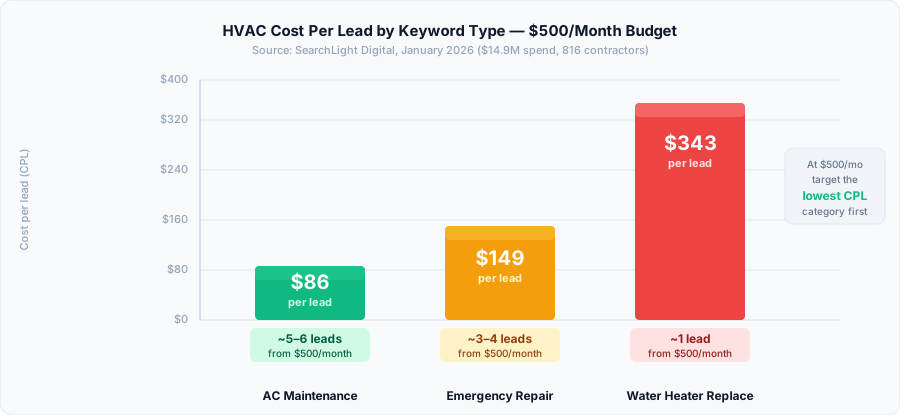
At $500/month, AC maintenance keywords ($86 CPL) get you 5–6 leads. Water heater replacement ($343 CPL) gets you one. Keyword selection matters more than campaign structure at this budget.
Pick one service and a tight geography. Run call-only ads. Skip traffic ads that send people to a website. Call-only ads ring your phone directly. Every dollar should push toward a conversation.
On geography: a 40-mile radius in a suburban market splits your budget across dozens of ZIP codes. You end up too thin to matter in any of them. Define your actual 5–8 mile service zone and own it.
One more thing if you're running ads: track whether those calls are being answered. Untracked ad spend with missed calls is paying Google to send leads to your voicemail, and then to your competitor.
The multiplier nobody's talking about
74.1% of HVAC calls go unanswered, according to Dexcomm's analysis of home service call data. When a caller hits voicemail, 80% don't call back. They dial the next contractor on the list.
That wrecks the math on either channel.
You spend $500 on Google Ads, drive 5 leads to your phone, miss 3 calls while you're under a unit on a 95-degree afternoon. Your effective cost per lead just jumped from $100 to $250. The ad spend partially funded your competitor's next job.
Same story for organic. Four months building your Google Business Profile, consistent reviews, pages starting to rank. A homeowner finds you Thursday afternoon, calls while you're finishing a job, hits voicemail, dials the next result. All that work sends someone else a customer.
For a full breakdown on what missed calls cost a shop your size, HVAC Missed Calls: What They're Actually Costing You runs the annual math. HVAC Lead Response Time: Why Minutes Decide Who Gets the Job covers what happens when you call back an hour later instead of five minutes.
Run your own numbers with the free missed-call cost calculator.
Neither channel produces its full return if calls are going unanswered.
The simple decision rule
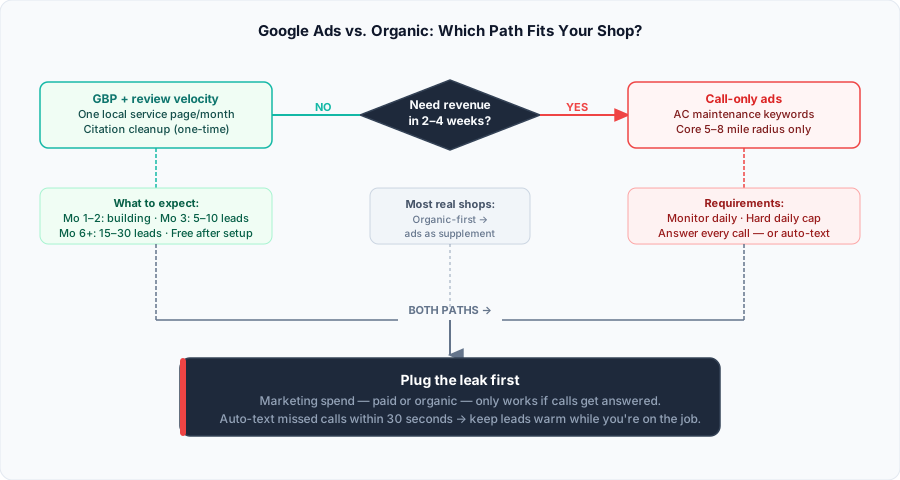
Need revenue in the next 2–4 weeks?
Run a tight call-only campaign on AC maintenance keywords in your core ZIP codes. Set a hard daily cap. Watch what converts. Have a plan for every call that comes in, whether that's picking up or having an auto-text go out within seconds when you can't.
If you can't monitor daily, $500/month in ads mostly teaches you what doesn't work. Spend that time on GBP and review velocity instead.
Building for next season?
Put the $500 into organic. Spend an afternoon cleaning up your Google Business Profile. Send a review request to every customer you served this month. Write one local service page. Repeat next month. By next season, you'll have ranking pages sending leads without a monthly check to Google.
Most real shops:
Start organic-first. Build the GBP foundation. Once rankings are moving and reviews are coming in consistently, layer in a defensive ad budget on the keywords where a competitor keeps showing up.
Whichever path you take, plug the leak first. Marketing spend, paid or organic, only works if the leads it generates actually get answered. HVAC Missed Call Text Back covers how automated text-back fits into either scenario.
The money you spend getting the phone to ring only matters if something happens when it does. ConnectFirst closes that gap. When a call goes unanswered, an automated text goes out within 30 seconds from your existing number, keeping the lead warm while you finish the job. See how it works →