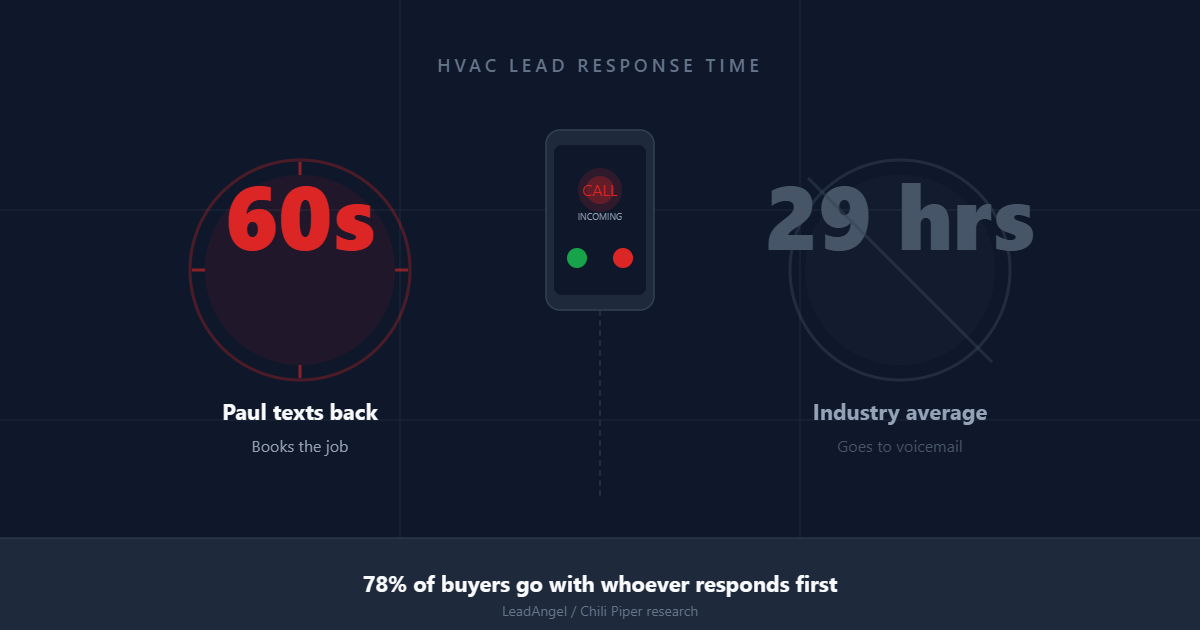
A homeowner's AC stops working at 1pm on a Saturday in July. She searches Google, finds four HVAC companies, and starts calling. She's not comparison shopping. She wants cold air before tonight.
She calls the first company. Goes to voicemail. She calls the second. Same. The third one texts back in under a minute: "Hey, this is Paul at Arctic Air. Just missed your call. AC issue? I can usually get out same day."
She texts back. Paul books the job. Companies one and two call her back that evening. She doesn't answer.
The deciding factor isn't price, reviews, or how long you've been in business. It's who responds first.
Quick summary
- 78% of buyers book the first responder, not the cheapest or best-reviewed
- For no-cool emergencies, your response window is roughly 20 to 30 minutes
- The average business responds in 29+ hours. You just need to be faster than that.
- A text back in 60 seconds is functionally equal to answering live
- Price doesn't compensate for slow. If you're late, the comparison already happened without you.
In this article
The First-Contact Advantage
Research compiled by LeadAngel across industries shows 78% of buyers go with the first company that responds to their inquiry. Not the most experienced. Not the cheapest. The first.
That number surprises most contractors when they hear it. It shouldn't. Think about your own behavior when you need a plumber, an electrician, anyone. You call a couple of options. Whoever gets back to you while you're still in problem-solving mode gets the job. Once you've mentally moved on or booked with someone else, a late callback is an interruption.
Chili Piper's research found 82% of consumers expect a response within 10 minutes of making contact. That's the baseline expectation for a significant majority of your potential customers, not a nice-to-have.
This isn't just a dynamic for big call centers and B2B sales teams. It's how residential service buyers behave, and it's more pronounced during the situations that drive most HVAC volume: heat emergencies, no-heat calls in winter, anything where the homeowner has urgency.
The Decay Curve: What Happens to Leads After 5 Minutes
Speed-to-lead research is mostly B2B in origin. The original data comes from sales teams managing inbound demo requests and web leads. I want to be upfront about that. But the underlying mechanism (leads go cold fast and competitors fill the gap) is if anything more severe in residential field service, where the buying window is same-day.
The Numbers
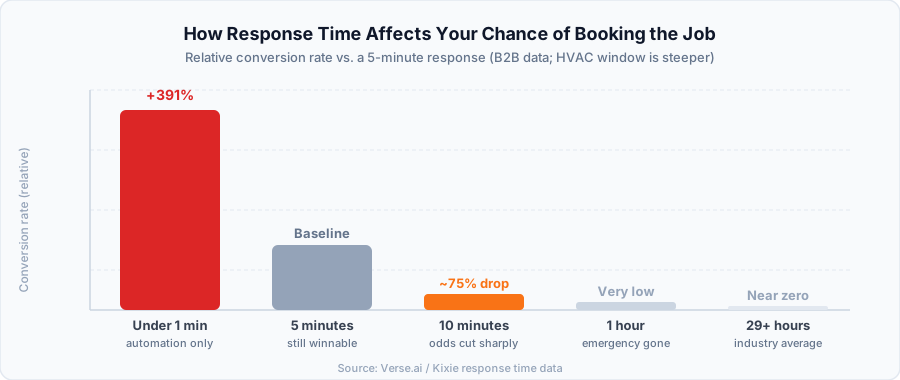
Verse.ai's compilation of response time data shows responding within one minute increases conversion rates by 391% compared to a five-minute response. Kixie's analysis found every 10-minute delay reduces conversion odds by roughly 400%.
And the median business response time? Over 29 hours, according to a 2024 analysis of more than 1,000 companies.
That last number is good news for small operators. You don't need to be exceptional. You need to be faster than a business that takes a day to respond, which is most of your competition. Want a number specific to your shop? The missed-call calculator runs the math in under a minute.
Why the Window Is Shorter for HVAC Than for B2B Sales
A B2B buyer evaluating software might be okay waiting a few hours for a demo response. They're in a multi-week buying cycle with multiple stakeholders. The urgency is low.
A homeowner with a non-functioning AC in July is in a buying cycle measured in hours, not weeks. They need this resolved today. If you don't respond while they're still actively problem-solving, they've already moved on.
The decay curve for HVAC leads isn't flatter than the B2B data. It's steeper.
Not All HVAC Calls Are Equal
Response time matters for every call type, but the urgency window is different depending on why they're calling.
No-Cool / No-Heat Emergency
This is your tightest window. A homeowner calling about an AC that died on a hot afternoon is calling multiple contractors simultaneously. They're not leaving one voicemail and waiting. They're working down a list.
Your window to be in the running is roughly 20 to 30 minutes. After that, someone else has likely already started a conversation. A callback at 4pm for a call that came in at noon doesn't compete.
Tune-Up or Maintenance Request
More forgiving. The homeowner isn't uncomfortable right now; they're being proactive. Your response window is a few hours, not minutes. But first contact still wins: if you respond within 30 minutes with a specific available time slot, you'll often book the job before they ever get around to calling a second company.
New Installation Quote
The most research-intensive of the three. Customers are comparing options, getting multiple quotes, and taking time to decide. Response time still matters (you want to be in the comparison), but a same-day response with a clear proposal is sufficient. Raw speed is less critical here than the quality of your first impression.
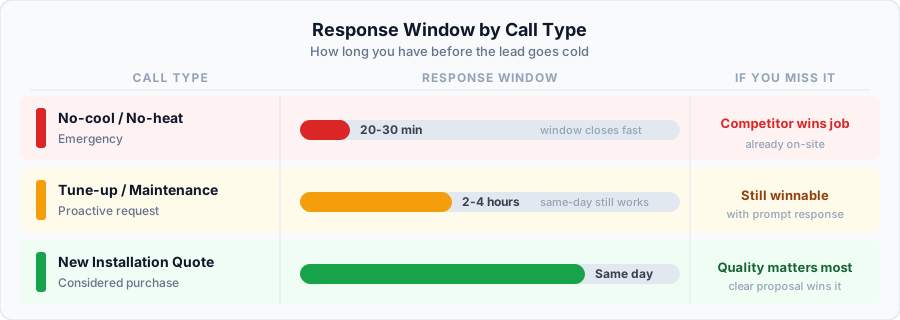
If you're going to prioritize fast response anywhere, prioritize it for emergency calls. Those are also often your highest-value jobs, especially in peak season.
What "Fast" Actually Requires
Let's be realistic about what's achievable when you're in the field.
Under 1 minute: achievable only with automation when you're on a job. Not possible manually while you're on a ladder.
Under 5 minutes: possible with systems, like an alert to a second person or an automated text-back that fires while you're working.
Same business day: better than most of your competition, but you're losing emergency calls to anyone faster.
2+ hours: in peak season, this is usually too late for no-cool calls. The job is gone.
Here's what most operators miss: answering live isn't the only way to stay in the running. A text back within 30 to 60 seconds is functionally equivalent to answering live for most callers. It signals you're responsive, starts the conversation, and keeps them from calling the next company on the list while you're still on the job.
Why Price Doesn't Compensate for Slow
I want to be direct about something, because I've heard the counterargument: "My pricing is competitive, people will wait."
They won't. Not for emergency calls. Not in summer.
Price comparison only happens when the buyer is actively comparing options. If you respond two hours after they called, the comparison has already happened without you. They're not comparing your $279 diagnostic fee against your competitor's $299 fee. They booked your competitor at 1:15pm and you called at 3:30pm.
Discounting doesn't fix a response time problem. It just means you earn less on the jobs you do get.
The operators who compete well on price and volume are usually the ones investing in answering services or automation. Not because they discount more, but because they respond faster and close more of the calls they're already generating.
The Practical Fix
You can't answer every call live. That's reality.
But you can make sure every missed call gets a response within 60 seconds, automatically, without any action on your part while you're working.
What does that response look like? Something like:
"Hey, this is Sarah at Comfort Air. Just missed your call. Is it an AC issue? I can usually get out same day. What's going on?"
Short. Specific. Not a blast. It opens a conversation, not a pitch. And it reaches them while they're still in problem-solving mode, before they've moved down the list to your competition. For template variations and what wording tends to perform well, this post on HVAC missed-call text-backs goes deeper on the copy side.
If you want to understand how the automation works and whether it's legal to auto-text someone who called you, the How It Works page covers both. The broader picture on missed call costs is in this post on what missed calls are actually costing you.
ConnectFirst texts missed HVAC calls back within 30 seconds. Your number, your message, nothing changes about how you work. Try the live demo → or get in touch →
Key Takeaways
- 78% of buyers go with whoever contacts them first. Not whoever's cheapest or best-reviewed.
- Responding within 1 minute increases conversion by 391%. A 10-minute delay cuts it by 400%.
- For no-cool emergencies in summer, your response window is roughly 20 to 30 minutes before the lead goes cold.
- The average business takes over 29 hours to respond. You don't need to be exceptional, just faster than that.
- A text back within 60 seconds is functionally equivalent to answering live for most call types.
- Price discounts don't compensate for a slow response. If you don't make contact in time, the comparison never happens.