There are roughly 259 HVAC contractors in Chicago proper. On any summer afternoon, a homeowner in Wicker Park types "AC repair near me" and sees three results. One of those shops answers. The other two don't.
Your Google Business Profile is the number one organic lead source for local HVAC work. More consistent than your website, cheaper than Angi. But most shops treat it like a yellow pages listing: claim it once, forget it, wonder why calls dry up. This guide covers what the active operators are actually doing differently.
In this article
- The Chicago GBP Map Pack: Why It Matters More Here
- Service Area Setup: Think Neighborhoods, Not "Chicago"
- Categories, Services, and Attributes That Match Chicago Search Behavior
- Chicago's Seasonal GBP Posting Calendar
- Adding Online Booking to Your GBP Listing
- The Missed-Call Gap: What Happens to GBP Calls You Don't Answer
- Monthly 15-Minute GBP Audit Checklist
The Chicago GBP Map Pack: Why It Matters More Here
The three local results that appear with pins when someone searches "HVAC near me" or "furnace repair Chicago" are called the map pack. In a market as dense as Chicago, those three slots drive the majority of organic job calls.
The numbers back this up. Service trade businesses see 10–15% call-click rates from GBP profile views, double the average for local businesses overall. On a normal day, that's a steady stream. During Chicago's first hot week (June 5–8 on average, per National Weather Service data), call volume spikes 3–5× and those GBP clicks spike with it.
With roughly 1,000 HVAC contractors across the Chicago metro competing for those three spots, rank matters. The good news: GBP ranks on relevance, distance, and prominence. Not ad spend. A 2-truck shop with a well-maintained profile and a steady stream of recent reviews can out-rank a company with 20 vans if that larger company is treating GBP as an afterthought.
Service Area Setup: Think Neighborhoods, Not "Chicago"
Setting "Chicago" as your service area tells Google you want to rank for a 234-square-mile city from a single location. That's too broad to be useful. You'll get diluted relevance for neighborhood-level searches, which is where buyers actually convert.
Address vs. service-area business
If you have a staffed office customers can visit, show the address. If you work from home or a shop with no walk-in traffic, hide the address and configure service areas only. Service-area-only listings rank more aggressively at the neighborhood level because Google treats them as more relevant to specific local searches.
Which neighborhoods to prioritize
Start with where you already get jobs. GBP service areas should reflect your real coverage. If you're chasing new territory, add one or two stretch zones. Don't claim the entire metro.
High-value Chicago zones for HVAC calls:
- Bungalow Belt — The NW→SW→S crescent of Chicago holds roughly 80,000 brick bungalows (Chicago Bungalow Association). Most have basement boilers that are 30–50 years old. Dense, repeat-service territory.
- Greystone corridors — Lincoln Square, Logan Square, Wicker Park, and West Town are lined with multi-unit greystones and two-flats running aging hydronic systems. One building can generate multiple calls.
- Dense two-flat areas — Bridgeport, Brighton Park, and Little Village run about 70% two-to-four-family buildings. A job on one floor often leads to referrals from the tenant upstairs.
- Near suburbs — Oak Park, Berwyn, Evanston, and Cicero have older housing stock similar to Chicago proper, with somewhat less competition from city-based contractors.
Set 5–8 specific neighborhoods or suburbs, not ZIP codes or the entire city. If you expand summer coverage for AC work or pull back in winter, update the service areas to match.
One underused tip: mention the neighborhoods you serve in your GBP business description. Google reads the description for relevance signals, and it reinforces your coverage area beyond the service area field itself.
Categories, Services, and Attributes That Match Chicago Search Behavior
Most shops pick one category and move on. Chicago's housing stock means your customers are searching for services that most national GBP guides never think to include.
Primary and secondary categories
Primary: "HVAC contractor." That's the baseline. Don't change it.
Secondary categories worth adding:
- Air conditioning repair service
- Furnace repair service
- Boiler repair service — Chicago-specific and almost always missing from national guides. Bungalows and greystones run Burnham, Weil-McLain, and Peerless steam and hot-water boilers. Homeowners searching "boiler repair Chicago" or "steam heat not working" represent a real call category that competitors without this secondary miss entirely.
- Heating contractor
- Air conditioning contractor (if you do new installs)
Services list: use plain language
List the jobs you actually want more of, using the words people say on the phone:
- AC tune-up, furnace tune-up, boiler tune-up
- "No cool" diagnostic
- Heat not working
- Mini-split installation
- Indoor air quality
- Duct cleaning
Tie service descriptions to real photos when you have them. A photo of a basement boiler replacement next to your boiler tune-up listing adds credibility that text alone can't.
Attributes and photos
Attributes like "Emergency service" and "Free estimates" show up in search results and filter views. Only mark them true if they actually apply. Wrong attributes surface in reviews fast.
For photos: a truck parked on a Chicago street (brick bungalow in the background works), before/after of a basement boiler or rooftop condenser, and a crew shot all convert well. Swap them seasonally: AC-unit photos in spring and summer, furnace and boiler shots in fall and winter. Stale profiles look inactive.
Chicago's Seasonal GBP Posting Calendar
GBP posts signal an active business. Google weights profile freshness in local rank, and posts are one of the few signals you fully control. For Chicago HVAC shops, the posting calendar isn't "post during peak season." It maps to specific weather events that drive real call spikes.
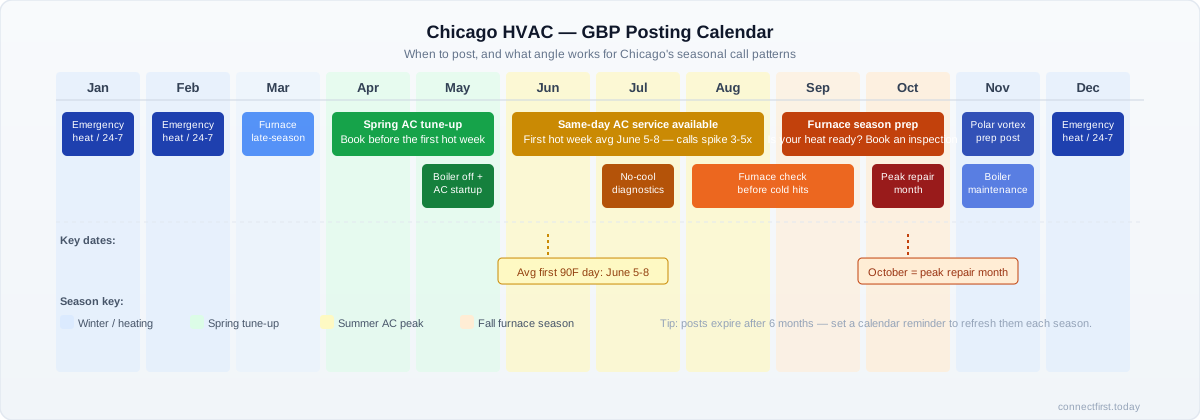
Here's what works, tied to Chicago's actual climate:
| Month | Post angle | Why | |-------|-----------|-----| | Mid-April | "Spring AC tune-up — book before the first hot week" | 8-week spring booking window opens here | | May | Boiler shutdown + AC startup combo | Unique Chicago service: two-visit jobs in one season | | Early June | "Same-day AC service available" | First hot week hits avg June 5–8; call volume spikes | | Late August | "Furnace check before the cold hits" | October is peak furnace repair month; book early | | October | "Is your heat ready? Book a furnace inspection now" | First cold snaps; no-heat calls spike | | November | Boiler maintenance + emergency heat availability | Polar vortex prep season begins | | December–January | 24/7 emergency heat service callout | Coldest months; after-hours call rate is highest |
For spring tune-up marketing, the window between mid-April and early June is the highest-leverage posting period of the year. AC demand is building but shops aren't slammed yet.
Formatting rules: Keep posts 2–3 sentences, factual, no hype. Google flags posts with ALL CAPS, excessive punctuation, or promotional language that looks spammy. Include a photo with each post; profiles with photos see meaningfully higher click-through rates. Posts expire after 6 months, so set a calendar reminder to refresh them.
Adding Online Booking to Your GBP Listing
GBP lets you add a "Book" button that routes searchers directly to your scheduling system. For tune-ups and inspections, this converts people who won't call back: the ones who want to book at 10pm from their couch after their AC starts acting up.
One rule before setup: only offer online booking for non-emergency services. Tune-ups, AC inspections, furnace checks, filter replacements. Emergency calls still need the phone. (For the calls you miss, that's covered in the next section.)
How the booking button works
Two options: add any scheduling URL to your GBP under Business Information → Appointments → Appointment links. Or, if your platform supports it, connect via Reserve with Google, which shows your real-time availability directly inside Google Search without any redirect.
Reserve with Google is the better option when it's available. Fewer clicks between "found your profile" and "booked a time."
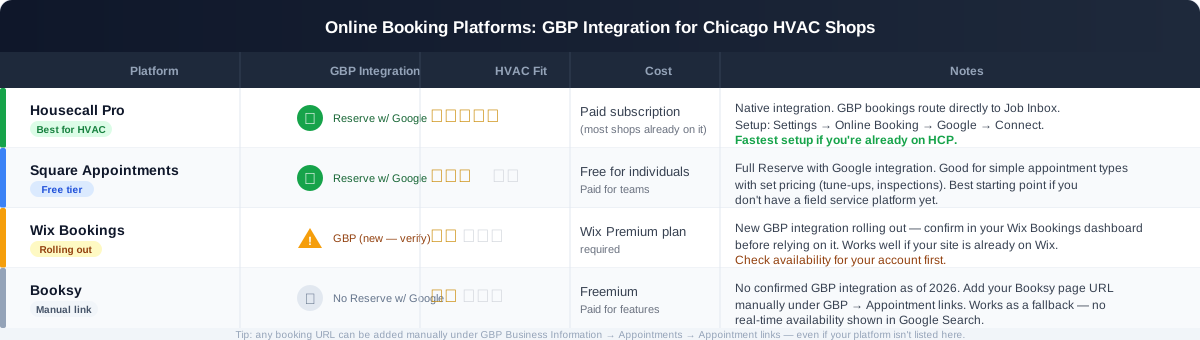
Platform comparison
-
Housecall Pro — Best fit for HVAC shops. Native Reserve with Google integration. All GBP bookings sync directly to your Job Inbox. Setup takes about five minutes: Settings → Online Booking → Google → Connect. If you're already on HCP, this is the obvious choice.
-
Square Appointments — Full Reserve with Google integration. Free for individuals. Works well for simple appointment types with set pricing. Good starting point if you don't have a field service platform and want something free to set up.
-
Wix Bookings — If your website runs on Wix (Premium plan), a newer GBP integration adds a Book button with availability sync. The integration is still rolling out, so check your Wix Bookings dashboard to confirm it's available for your account before relying on it.
-
Booksy — No confirmed Reserve with Google integration as of 2026. If you use Booksy, paste your customer-facing booking URL manually into GBP's Appointment links field. It won't show real-time availability in Google, but it still gives searchers a next step.
Any booking page URL (Calendly, a simple form, a custom page) can be added manually as an appointment link. It's not as seamless as Reserve with Google, but it's better than nothing and takes two minutes to set up.
The Missed-Call Gap: What Happens to GBP Calls You Don't Answer
GBP does its job. The homeowner searched, saw your listing, tapped the phone icon. The call comes in while you're elbow-deep in a condenser on a roof in Andersonville. It rings out.
That's not an edge case. It's the norm.
The numbers
HVAC shops miss 20–35% of inbound calls on an average day. During peak season (first hot week, polar vortex, the first October cold snap), that number climbs to 40–50%. The average Chicago shop handles around 450 calls per month; in summer, that spikes to roughly 635 (Samsara fleet data).
Of those missed callers, only 15–20% leave a voicemail. The other 80–85% call the next contractor on the list. At $450 per job, 10 missed calls a week is $18,000–$20,000 in lost revenue during the month you can least afford to miss it.
In Chicago, with 259 competitors in the city, the next shop is three search results away.
What missed-call text-back does
When a call goes unanswered, ConnectFirst automatically texts the caller within about 30 seconds. The message is customizable. Something like: "Hi, this is [Shop Name]. We missed your call. We'll be with you shortly. Want to book a time?"
Most missed callers haven't dialed the next shop yet. That 30-second window is where you either keep the lead or lose it. A text catches them in that gap, confirms you're aware of their call, and gives them a path to book without waiting on hold.
Inbound replies come to your email so you don't need to monitor a new app. If your GBP links to a contact form, the same system auto-replies to form submissions with a confirmation email and optional SMS. Same lead recovery, different channel.
For a deeper look at how missed-call text-back works in practice, that post covers the full flow.
Running GBP calls you can't always answer?
ConnectFirst auto-texts missed calls within 30 seconds from your existing business number — before the caller dials the next shop on the list.
See how it works →Monthly 15-Minute GBP Audit Checklist
GBP profiles decay quietly. Google auto-suggests category edits. Holiday hours go stale. Photos from last summer show up in October. A monthly 15-minute review catches the drift before it costs you rank.
Run through these once a month:
- Hours — Are they current? Include holiday closures, any Saturday/Sunday changes, and emergency-only hours if you have them.
- Category edits — Did Google suggest a change? Review it. Accept accurate suggestions; revert anything that broadens or misrepresents what you do.
- Services — Added or dropped any jobs recently? Update the list.
- Photos — Any seasonal shots that now look wrong? Swap them. Remove duplicates or blurry uploads.
- Reviews — Any from the past 30 days without a response? Respond to every one, especially negatives. A professional response to a bad review often matters more to prospective customers than the review itself.
- Posts — Publish one new post this month. Refresh or remove anything older than 6 months.
- Booking link — Still live? Still routing to the right page?
- Service area — Did your coverage change this season?
- Q&A section — Anyone asked a question you should answer? Unanswered questions look neglected.
Understanding why small shops miss more calls than they realize is worth reading alongside this. The same operational patterns that cause missed calls also cause GBP maintenance to slip.
In a city with 259 HVAC contractors competing for three map pack slots, most shops are leaving their GBP on autopilot. The gap is real: post seasonally, add a booking link for tune-ups, make sure boiler repair is in your categories, and have a plan for the calls that come in while you're on the job.
The shops pulling ahead aren't spending more on marketing. They're just running their GBP like a channel instead of a listing.
If you want to make sure every GBP call gets a response, even when you're elbow-deep in a rooftop unit, that's what ConnectFirst is for.