Most Chicago HVAC operators can't tell you how many calls they missed last week. Not because they don't care. There's no system logging it. The call rings while you're in an attic in Bridgeport. Goes to voicemail. The caller hangs up without leaving a message. By Friday, that call doesn't exist in any record.
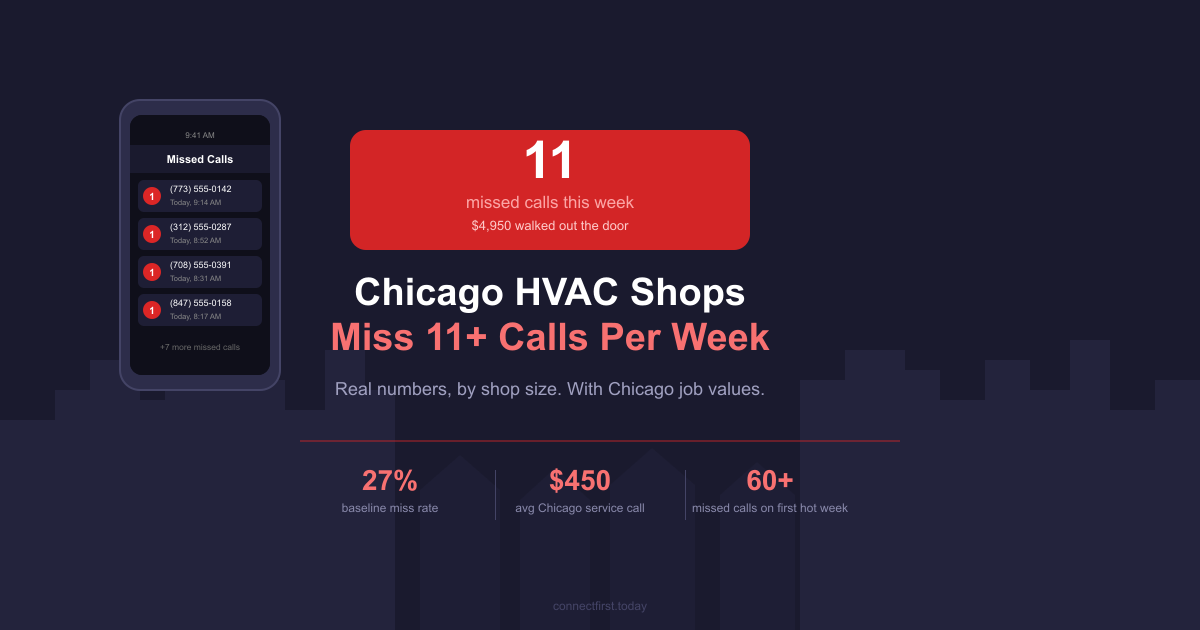
A 3-truck Chicago shop misses roughly 11 calls in a normal week. During the first hot week of June, that number jumps past 60.
This post does the math by shop size, by season, using Chicago job values rather than the national averages that understate what each missed call actually costs you here.
Quick Summary
- Most Chicago HVAC operators have no idea how many calls they're missing. The number is invisible without call tracking
- Industry miss rates run 22–27% even with office staff; for owner-operators with no dedicated coverage, it's higher
- A 2-truck Chicago shop misses roughly 11 calls per week in normal season; a 4-truck shop misses about 22
- Chicago service calls average $450. Each missed call costs more here than the national "$350" figure
- The first hot week of June (avg June 5) triggers a 3–5x call surge; a 2-truck shop can miss 60+ calls that week
- Chicago has a second annual spike in October and November, the fall boiler startup, that most markets don't have
In this article
- 1. Most Chicago Shops Don't Know How Many Calls They Miss
- 2. The Baseline: Industry Miss Rates for Small HVAC Shops
- 3. The Chicago Math: How Many Calls You Lose Per Week
- 4. The June Surge: What Happens on Chicago's First Hot Week
- 5. The Fall Boiler Spike That Most Guides Ignore
- 6. What It Adds Up to Annually
- 7. How to Stop Losing Calls Without Adding Staff
Most Chicago Shops Don't Know How Many Calls They Miss
The number is invisible without call tracking. That's the whole problem.
One HVAC owner profiled by CallJolt discovered he was missing 8–10 calls per week, but only after installing call tracking. He'd assumed he was catching most of his inbound volume. He wasn't. When a call went to voicemail, no alarm fired. No log entry appeared. No count incremented somewhere.
This is the default for most 1–4 truck shops. The owner is also the tech. When he's diagnosing a heat pump in Oak Lawn or running a service call in Pilsen, calls go unanswered. 62% of those callers won't leave a voicemail. They hang up and dial the next shop on the list. No message means no record. No record means no awareness of the loss.
Operators underestimate the problem for exactly this reason. They think: "I get back to people pretty quickly." What they mean is: "I return the voicemails I receive." That's not the same thing.
Before we get to the math, it's worth sitting with this: you probably don't know your actual miss count either. I'd be surprised if you did. Most shops don't.
The Baseline: Industry Miss Rates for Small HVAC Shops
Industry data puts the baseline miss rate at 22% for HVAC companies, per IBISWorld market research. A separate Invoca study of home services businesses puts it at 27% of inbound calls going unanswered even when office staff is present.
Either way: roughly 1 in 4 calls doesn't get answered by a shop that has someone at a desk.
For an owner-operator running 1–3 trucks with no dedicated phone coverage, the rate is higher. A ServiceTitan and ACCA survey found that 65% of HVAC companies handle peak-season demand by extending technician hours, not by adding call coverage. The owner works a 12-hour day, takes more jobs, but nobody new answers the phone. The miss rate holds or climbs because he's more stretched, not better staffed.
One more number worth knowing: 62% of HVAC calls come in outside regular business hours, per ACHR News data. If your phone stops being answered at 6pm, you're forfeiting more than a third of your inbound volume by default, and that's before the peak-season math even comes into play.
The Chicago Math: How Many Calls You Lose Per Week
Here's what those miss rates mean in actual calls and dollars, broken down by shop size.
Assumptions for normal season:
- Call volume: 40 calls/week for a 2-truck shop, 80 for a 4-truck shop (standard residential HVAC benchmark)
- Miss rate: 27% (conservative baseline, assumes some phone coverage)
- Chicago average service call value: $450 (residential range: $116–$993 per Chicago Comfort HVAC and Cook County data; emergency calls skew toward the upper end)
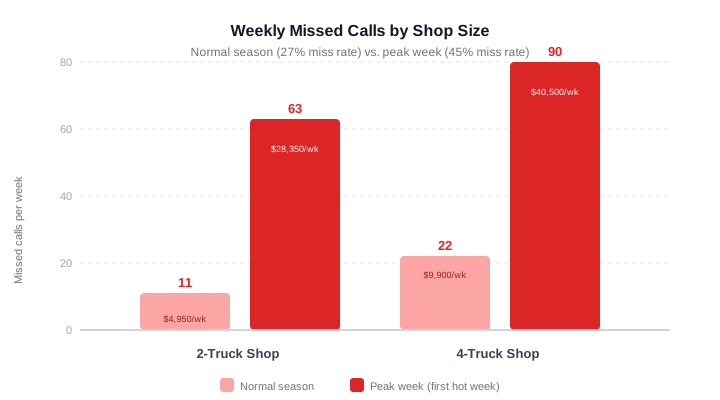
| Shop size | Calls/week | Missed (27%) | Avg job value | Weekly missed-call cost |
|---|---|---|---|---|
| 2-truck | 40 | ~11 | $450 | ~$4,950 |
| 4-truck | 80 | ~22 | $450 | ~$9,900 |
These are normal weeks. Not July heat waves, not November cold snaps. Regular mid-season weeks when call volume is moderate and you're reasonably busy.
The widely cited "$350 per missed call" is a national average. Chicago runs higher. AC installations average $5,396–$7,402 here. Furnace replacements run 8–12% above the national average because of stricter permitting and regional labor rates of $85–$100/hour. A missed call in Chicago isn't a $350 miss. It's a $450+ service call, and sometimes it's the furnace replacement that started as a service inquiry.
11 missed calls this week. What did that cost you?
ConnectFirst texts every missed caller within 30 seconds, automatically, from your existing business number. $99/month. About 20 minutes to set up.
Get in touchThe June Surge: What Happens to Your Calls on Chicago's First Hot Week
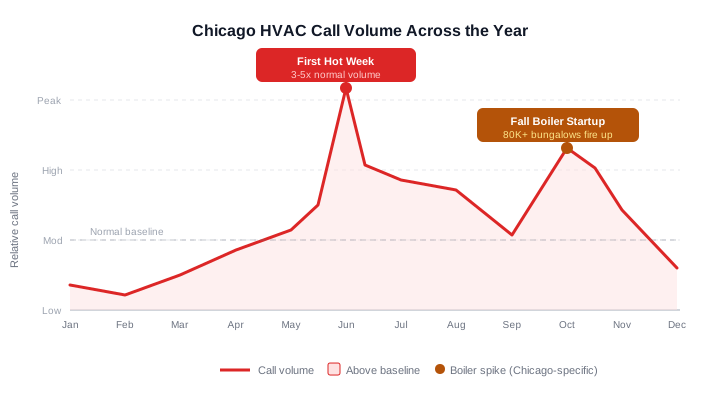
Chicago's first 90°F day averages around June 5, per NWS historical data, though the date shifts a week or two year to year. When it arrives, every homeowner whose AC has been off since September finds out whether it still works. Most of them call HVAC companies the same week.
Call volume jumps 340% from spring to peak summer across the industry. During the first-hot-week surge itself, operators report 3–5x normal volume in a single week. A 2-truck shop handling 40 calls in a regular week suddenly faces 140+. The techs are booked solid on emergency AC calls. There's nobody left to answer the phone. Miss rate climbs from 27% to 40–50%.
The math for that week:
| Shop size | Surge calls/week | Missed (45%) | Avg job value | One-week missed-call cost |
|---|---|---|---|---|
| 2-truck | ~140 | ~63 | $450 | ~$28,350 |
| 4-truck | ~200 | ~90 | $450 | ~$40,500 |
Sixty-three missed calls in a week isn't a worst-case projection. It's what happens when a 2-truck shop hits the first hot week without any call recovery in place.
And this happens every year, on a roughly predictable schedule. The specific date moves, but the surge doesn't. For the full prep guide on staffing, pre-season outreach, and what to tell callers when volume spikes, see Chicago HVAC First Hot Week: When AC Repair Calls Explode.
The Fall Boiler Spike That Most Guides Ignore
Most HVAC busy-season content focuses on summer AC calls. Chicago has a second annual call surge that most markets don't.
More than 80,000 brick bungalows in the bungalow belt, running from the Northwest Side through the Southwest and South sides, run on boilers, not forced air. The greystone corridors in Lincoln Square, Logan Square, Wicker Park, and Pilsen do too. These buildings have radiators. When temperatures drop in October and November, boilers that haven't run since April get fired up. Some work fine. A lot don't.
Every October, the pattern repeats: homeowners wait until the heat stops working, then call. They all call at once. The shop that was just winding down from summer suddenly has a full schedule and more inbound calls than two weeks ago.
Samsara fleet data shows October is the busiest month of the year for HVAC by fleet metrics, not July. In Chicago, older steam and hydronic systems push that October spike higher than it runs in Phoenix, Dallas, or Atlanta. The surge in the chart above is real and predictable. Shops that think busy season ends in August find out otherwise every October.
What It Adds Up to Annually
Here's a rough annual picture for a 2-truck and 4-truck shop. The assumptions: 32 normal-season weeks at 27% miss rate, and 4 high-intensity weeks (first hot week + early fall boiler startup) at 45% miss rate.
| Shop size | Normal weeks (32×) | Surge weeks (4×) | Annual missed calls | At $450/call | At 50% booking rate |
|---|---|---|---|---|---|
| 2-truck | 11/wk = 352 | 63/wk = 252 | ~604 | $271,800 | ~$135,900 |
| 4-truck | 22/wk = 704 | 90/wk = 360 | ~1,064 | $478,800 | ~$239,400 |
The "50% booking rate" column is more useful. Not every answered call converts to a booked job. But at 50% conversion, which is conservative for residential emergency calls, a 2-truck Chicago shop loses roughly $135,000 per year in jobs it never knew it missed.
Your number will be different depending on call volume, neighborhood, and how much of the day your phone goes to voicemail. Want to plug in your actual numbers? Use the ConnectFirst missed-call calculator to get a figure specific to your shop.
If you want the broader picture of why Chicago shops lose jobs before the estimate even happens, this post covers eight reasons, missed calls among them.
How to Stop Losing Calls Without Adding Staff
Three options. Here's what each one actually looks like in practice.
An answering service runs $200–$400/month for a human to field your calls. The person doesn't know your pricing, your lead times, or which neighborhoods you cover. Every caller gets a generic intake. Better than voicemail, but at 1–3 trucks it's expensive for what you get.
Hiring a dispatcher makes sense at 5+ trucks when call volume justifies a full-time role. For a smaller shop, you're adding a salary to solve a part-time problem.
Missed-call text back is the right-sized tool for 1–4 truck shops. Every caller who doesn't get an answer receives an automatic text within 30 seconds, from your existing business number. The lead stays warm. Nobody needs to be at a desk. ConnectFirst does this for $99/month; most shops are running in under 20 minutes.
If you're losing calls and want to stop, get in touch and we can have you set up this week.
Key Takeaways
- Most Chicago HVAC operators have no idea how many calls they're missing. The number is invisible without call tracking
- The industry baseline miss rate is 22–27% even with office staff; for owner-operators handling calls and jobs simultaneously, it's higher
- A 2-truck Chicago shop misses roughly 11 calls per week in normal season; a 4-truck shop misses about 22
- Chicago service calls average $450. Each missed call costs more here than the national "$350" figure
- The first hot week of June (avg June 5) drives a 3–5x call surge; a 2-truck shop can miss 60+ calls that single week
- Chicago has a second annual surge in October and November, the fall boiler startup spike, that most markets don't experience
- For 1–4 truck shops, missed-call text back ($99/month) is the right-sized solution; answering services and dispatchers cost more and are built for larger operations

ConnectFirst
ConnectFirst helps small HVAC shops stop losing jobs to missed calls. When a call goes unanswered, the system texts the caller back within 30 seconds, automatically, from your existing business number. $99/month. No new app required.
connectfirst.today