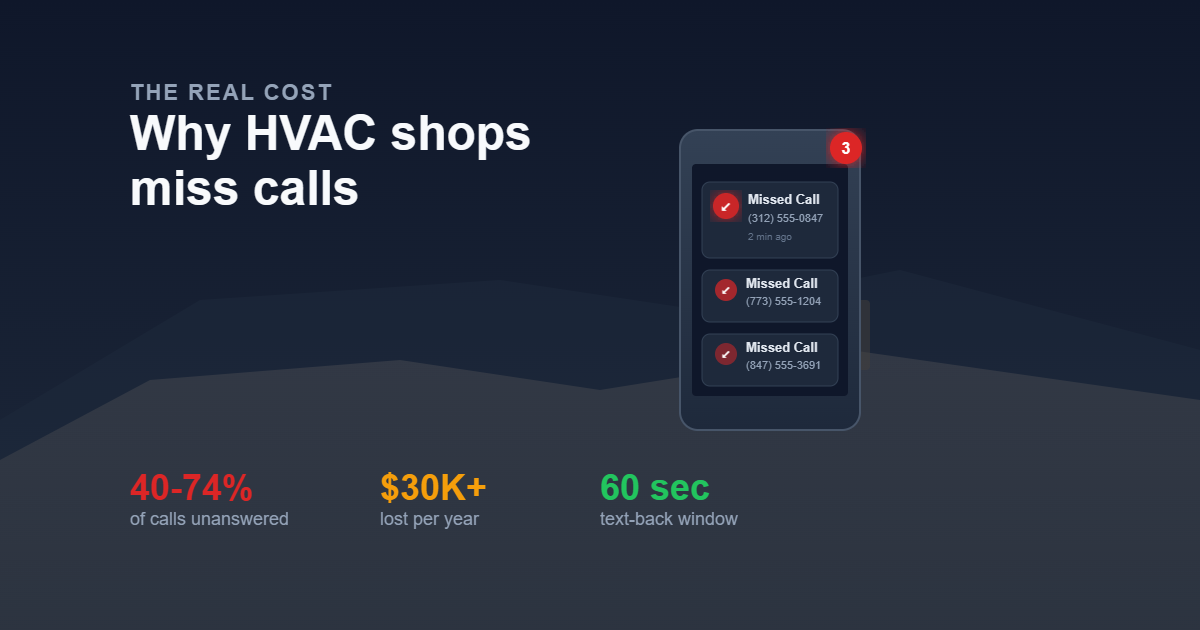
It's 2pm on a Thursday in July. You're in an attic running refrigerant, sweat dripping into your eyes, phone clipped to your belt. It rings three times. Goes to voicemail.
By the time you resurface 40 minutes later, that caller has already booked with someone else.
That's not a hypothetical. For most residential HVAC operators running lean (one tech, maybe two), that's Tuesday. Most operators know they miss calls. What they haven't done is run the math on what those calls actually cost. So let's do that.
In this article
Why Calls Go Unanswered (And Why It's Not Your Fault)
Before the numbers, some context. Missing calls isn't a discipline problem. It's a structural one.
You're under a unit and physically can't hear the phone ring. You're already on a call with a customer who's asking three follow-up questions. You're driving between jobs and you're not picking up at 60mph. It's 8pm on a Saturday and you've been working since 7am.
None of that is unusual. That's just what running a field service operation with one or two people looks like. The problem isn't that you're not trying hard enough. It's that you've got no system for the gap between when customers call and when you can actually respond.
How Many Calls Are You Actually Missing?
Most operators I've talked to estimate they miss maybe 20-30% of their calls. The data says it's worse than that.
Dexcomm's analysis of home service contractor call data found 74.1% of calls went completely unanswered. CallBird AI's research puts contractor miss rates in a similar range, with annual losses from missed calls running $45,000–$120,000 for active small operators.
That 74% figure may feel high for your operation. Maybe it is. But here's the thing: most operators only know about calls they heard ring. The ones that came in while you were under a unit, in a crawl space, or already on another call? You never knew they happened.
If you have a tracking number with call logs, go look. The miss rate is probably higher than you think.
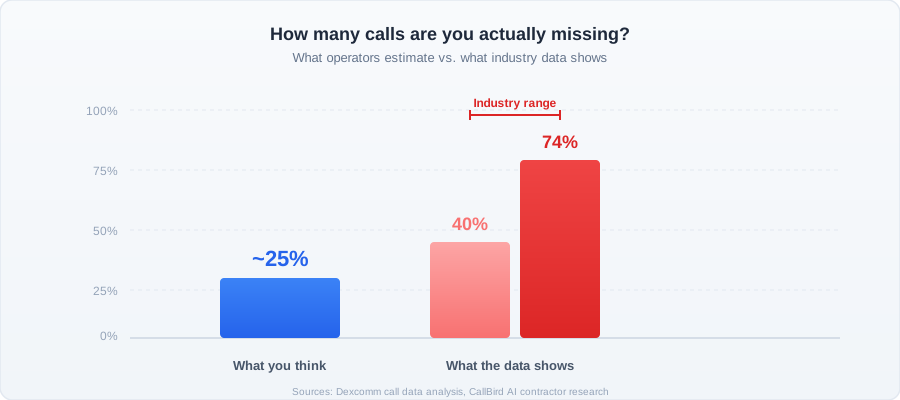
Most operators think they miss about 1 in 4 calls. Industry data says it's closer to 1 in 2 -- or worse.
The Real Cost Per Missed Call
Most operators think of a missed call as one lost job. A service call worth $300-$600. An install worth $4,000-$7,000. That's the visible cost, and it's the wrong number.
WhatConverts puts the average residential HVAC customer at ~$15,340 over the full relationship -- service calls, maintenance contracts, and the system replacement that eventually comes for every unit.
That missed first call isn't a $500 service call. It's the start of a 12-year relationship that went to your competitor.
Running the Annual Math
Let's use conservative numbers. Say you get 80 inbound calls a month. You miss 35%, which is well below the industry average. That's 28 missed calls monthly.
Of those 28 callers, most won't leave a voicemail and won't call back (more on that in the next section). Maybe 15–20% would have booked if you'd answered or responded quickly. That's 4–5 lost bookings per month.
At $500 per job average: $2,000-$2,500 in lost revenue every month. Over a year, that's $24,000-$30,000 in jobs that called you and got nothing.
Now factor in that even two of those annual callers would have become repeat customers. At $15,340 LTV each, that's $30,000+ in lost lifetime revenue from callers who were never even your customers yet. Your actual miss rate and volume are probably higher.
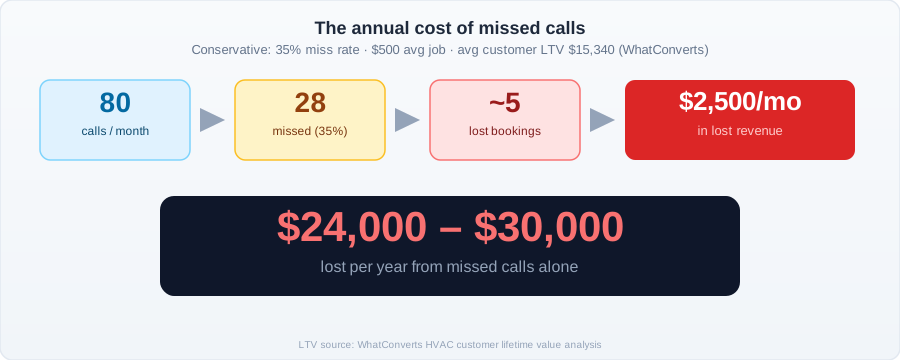
Conservative math: even at a 35% miss rate -- well below industry average -- a small HVAC shop loses $24K-$30K per year.
Want to run the numbers for your shop? Use the free missed-call cost calculator →
Why Voicemail Doesn't Save You
I hear this one a lot: "I have voicemail. People leave messages."
Some do. Most don't.
Research from RingEden found that 80-85% of callers won't call back if their first call goes unanswered. Of the ones who do reach voicemail, 80% hang up without leaving a message.
Voicemail was designed for a world where your business was the only game in town and a caller had no easy alternative. That world doesn't exist anymore. When a homeowner's AC dies at noon in July, they search Google, see five HVAC companies, and start calling down the list. Leaving you a voicemail means waiting. They're not waiting.
The ones who do leave a message? Many of them have already called two other companies by the time you listen to it and call back. If someone else answered, your callback is an interruption to a conversation they're already having with your competitor.
The Speed Problem: Why Calling Back Later Usually Fails
Even when you do call back, the window might already be closed.
Research across service industries shows 78% of buyers go with whoever contacts them first -- not the best reviewed or cheapest.
Here's the scenario: a homeowner calls four HVAC companies at 11am on a hot day. Company A texts back in 45 seconds. Company B calls back at 1pm. Company C calls back the next morning. Company D never responds.
Company A booked the job before B or C even picked up the phone. That's not an edge case -- it's how residential buyers with urgency and options actually behave.
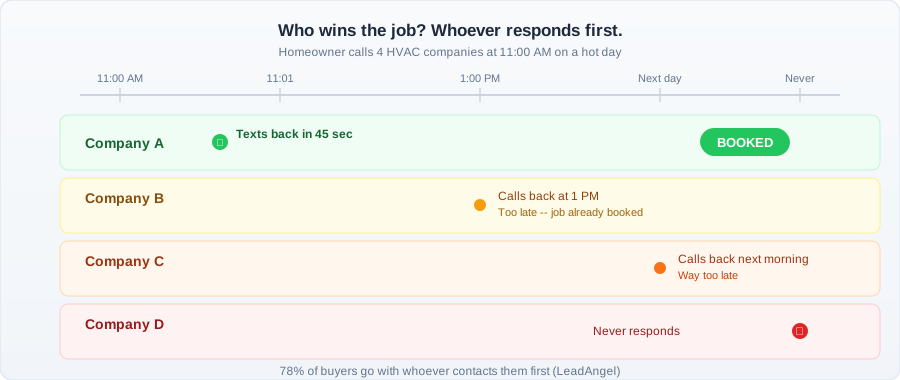
The homeowner books whoever contacts them first. Company A won this job 2 hours before Company B even tried.
We broke down what happens to a lead at 5 minutes, 10 minutes, and 2 hours in this post on HVAC lead response time. The short version: calling back two hours later works far less often than most operators assume.
What Actually Works
You need a system for this.
When you miss a call, the single most effective thing you can do is send a text within 60 seconds. Not a callback attempt that rings to their voicemail. Not an email they'll see at 9pm. A text.
SMS has a 98% open rate -- 90% read within three minutes. Email sits around 20%. A callback might not get picked up at all. A text reaches them while they're still standing next to the broken unit, phone in hand.
The message doesn't need to be clever. Something like:
"Hey, this is Mike at Peak HVAC. Just missed your call. What's going on with your system? Happy to help today."
It's short and it opens a conversation instead of asking them to call you back. For a prospect choosing between four HVAC companies, that responsiveness is what tips it.
Doing this manually every time you're under a unit isn't realistic. That's what auto text-back is for. If you want to understand how that works and whether it's legal to do automatically, both questions are answered in this post on how auto text-back works.
If you're losing $24K/year to missed calls, a $99/month auto text-back pays for itself on the first recovered job. ConnectFirst texts missed calls within 30 seconds -- no new phone, no new carrier, 20-minute setup. Try the live demo → or get in touch →
Key Takeaways
- Industry data shows 40–74% of calls to HVAC contractors go unanswered. Most operators underestimate their own miss rate, especially during peak season.
- 80% of callers who reach voicemail or get no answer won't call back. Voicemail is not a safety net.
- The real cost of a missed call isn't the job value. It's the customer's potential lifetime value (~$15,340 for the average residential HVAC relationship).
- Using conservative assumptions, a small HVAC operator can easily lose $24,000–$30,000 per year in revenue from missed calls alone.
- Calling back 2+ hours later fails most of the time. 78% of buyers book with whoever contacts them first.
- A text within 60 seconds of a missed call gives you a shot at the job even when you can't pick up.