You drove out. Spent 45 minutes on the walkthrough. Put the quote together that night, sent it over, then nothing. Three days of silence.
You have four jobs on the schedule and a parts run in the morning, so that lead never got a call. You are already half-sure they picked someone else.
Maybe they did. Often the other shop wins because they sent one follow-up text, not because they were cheaper or better.
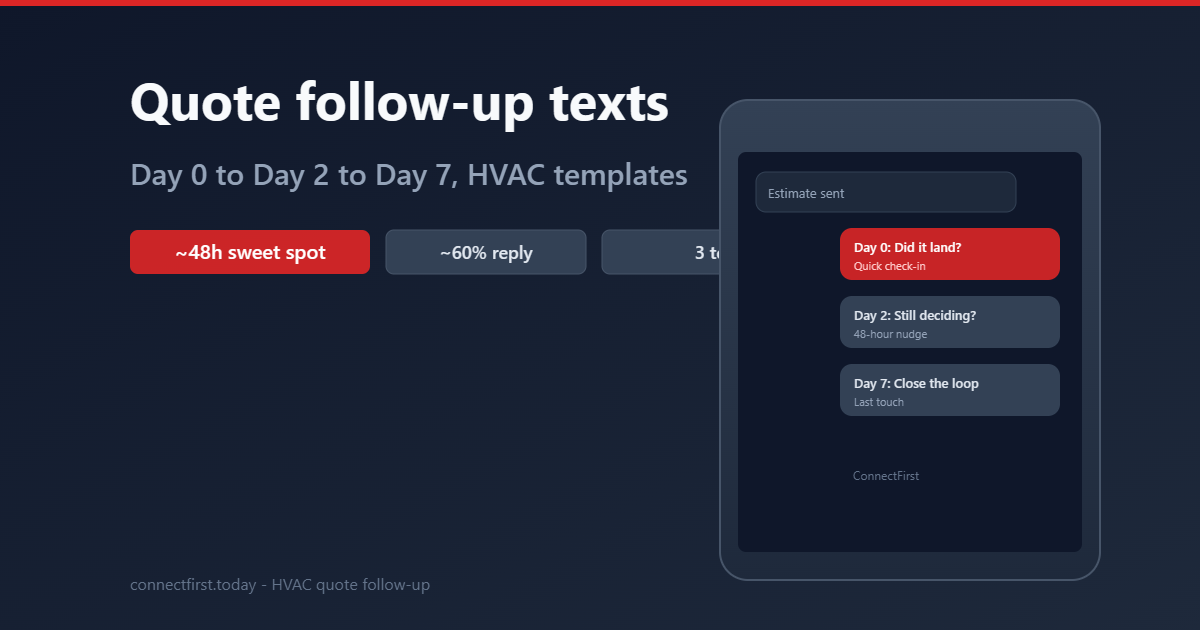
This post is that system: a three-message hvac quote follow up text rhythm, copy-paste templates, when to send, and how to set it so it runs every time you send an estimate.
If you are losing people before they ever get a quote, start with HVAC missed call text back. For what silence costs in dollars, see HVAC missed calls: what they're actually costing you.
Quick summary
- A 3-text sequence at Day 0, Day 2, and Day 7 catches most ghosted HVAC quotes
- Texts are read within about three minutes on average; calls often hit voicemail
- About 60% of homeowners respond to a 48-hour follow-up text in Hatch's HVAC campaign data
- Saturday sends can roughly double response versus Tuesday–Thursday in some datasets
- Automate once so you are not chasing quotes from memory
In this article
Why HVAC Quotes Get Ghosted (and What It's Costing You)
Silence is easy to take personally. You did the walkthrough, priced fair, and the inbox went quiet. Usually the homeowner is not gone forever. They are comparing three quotes, life got loud, or your PDF landed under a Home Depot receipt and never opened.
A few patterns show up again and again:
Email hides quotes. The homeowner asked several contractors for numbers. Everyone sent a PDF within a day or two. Those messages sit in one pile. No ping, no thread, no reason your file pops to the top.
Response drops fast after a few days. Hatch analyzed HVAC estimate follow-up campaigns and reported that replies fall off sharply after about 72 hours. If you are not in front of them inside that window, someone else will be.
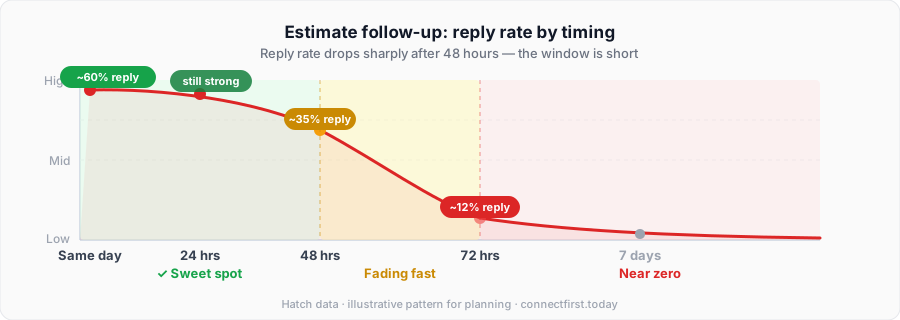
Qualitative curve: strong replies early, sharp drop after ~72h (per Hatch campaign reporting).
Most shops never follow up. HubSpot's sales research, often quoted in the trades, found 48% of salespeople never follow up after first contact. Another 44% stop after a single try. Standing out takes a follow-up habit, not a better truck wrap.
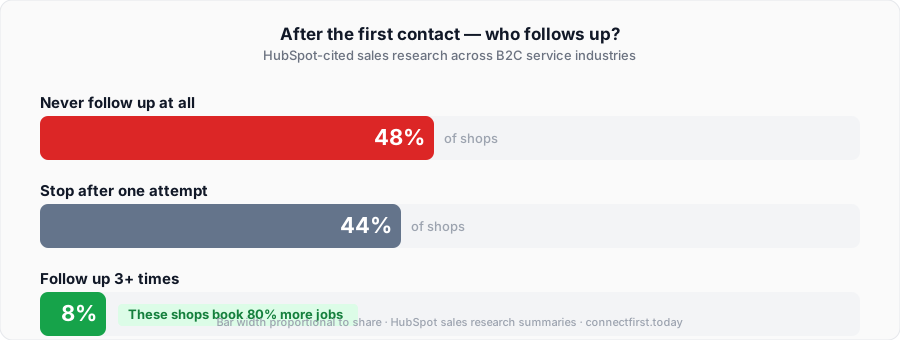
Shares from HubSpot-cited sales research (see link above).
Rough math. Say you run three trucks, send 15 estimates a month, close about 30%. That leaves 10 or more quotes that did not close. If even 15% of those would book with a follow-up text, that is one to two extra jobs a month. At an average ticket of $2,000–$5,000, that is $2,000–$10,000 a month left on the table because nobody texted.
One recovered job a month from a simple sequence is 12 jobs a year. At $3,000 average ticket, that is $36,000 a year that texts do not magically create. They recover work you already paid time to price.
Why Text Beats Phone and Email for Quote Follow-Up
Phone and email are fine tools. For quote follow-up in a small shop, they are usually the wrong default.
You are in the field. You cannot stop on a roof to call five leads. A text takes a few seconds from the truck. It gets sent. A mental note does not.
Calls miss people. A 2 p.m. Tuesday call from an unknown number often goes ignored. Work, kids, meetings. Voicemail does not fix it; they meant to call back and did not.
Email stays buried. Your PDF sits next to two other PDFs. No notification pulls them back. They are not singling you out. They are ignoring everyone.
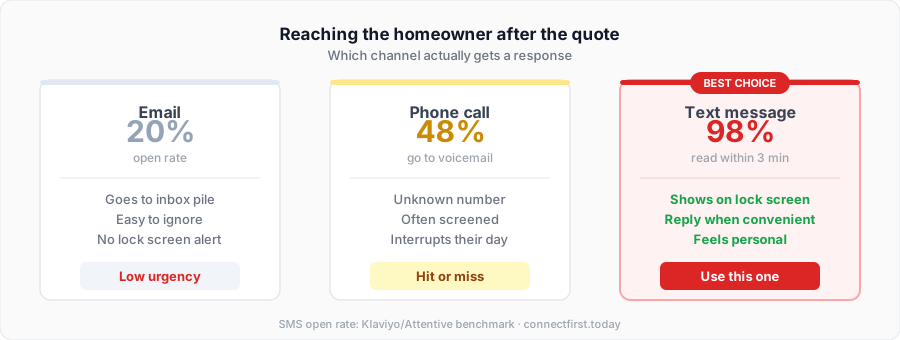
Text is different. SMS open rates are often quoted around 98%; read times of a few minutes show up across SMS studies for years. The notification sits on the lock screen until they tap.
Replying takes almost no friction. "Still thinking" takes one thumb. A phone call takes time and headspace. That gap is why response rates look so different.
Hatch's HVAC-specific numbers show about a 60% response rate for 48-hour follow-up texts, with strong operators higher. Shops that move from email-only follow-up to text are not suddenly writing Shakespeare. They switched channels.
The 48-Hour Sequence: Day 0, Day 2, Day 7
Three texts. That is the full system.
You do not need a dozen touches for a residential job. A long B2B nurture sequence is for six-month deals. For HVAC, the decision usually happens in about a week or it does not. Three messages inside that week, spaced on purpose, covers it.
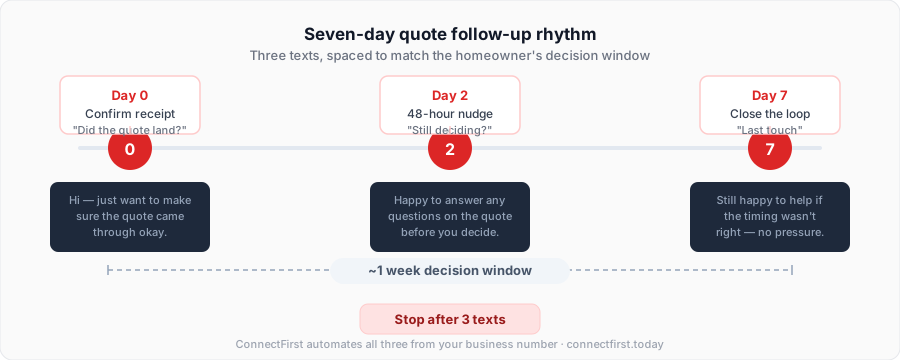
Day 0: Same Day (1–2 Hours After Sending the Quote)
Goal: Confirm receipt, show a human behind the quote, and make questions easy.
Most contractors send the PDF and disappear. This text does the opposite. It shows attention and gives them an easy out if they are not ready to decide.
Hi [FirstName], this is [YourName] from [Company]. Just sent over the estimate for your [system/job type]. Let me know if you have any questions. Happy to walk through anything.
Keep it short. No pitch. You are confirming it landed and that you are a person, not a mail merge.
Same day matters because you are still fresh from the walkthrough. Wait too long on the first message and you blend in with every other contractor.
Day 2: The 48-Hour Follow-Up
Goal: Nudge before the window closes.
This is the text that does the most work. Hatch's HVAC estimate data points to the 48-hour mark as the sweet spot: strong responses there, much weaker after 72 hours. They have had time to read the file; they have not always moved on.
Hey [FirstName], wanted to check in on the estimate I sent over for your [system/job type]. Happy to adjust anything or answer questions. Still available to start [earliest start date] if that timing works. — [YourName]
This message re-establishes context (they may not remember which quote was yours), invites adjustment instead of a hard yes/no, and gives a concrete next step with your availability.
Timing: If Day 2 lands on a weekday afternoon, try scheduling for Saturday morning. BuildFolio reported one operator seeing about 22% response on Saturday versus 11–13% Tuesday through Thursday. People are home and thinking about the house. Small edge, zero cost.
Day 7: The Last-Chance Nudge
Goal: Close the loop without pressure.
By Day 7 they either decided or parked the job. This text is not a hard close. It is staying the shop they remember when they are ready, and giving undecided people a clean reason to reply.
Hi [FirstName], just following up one last time on the estimate for [system/job type]. If you've gone with someone else, no worries at all. Just let me know so I can close it out. If you're still deciding, I'm around to answer any questions. — [YourName]
"One last time" signals you will not keep texting. "If you went with someone else" makes it easy to answer honestly. Operators report this message alone recovers jobs where the quote sat unopened for a week. Life happened, or the other shop dropped the ball.
You also get closure. Either they answer or they do not. You stop guessing whether the lead is warm.
The "Am I Being Annoying?"
A lot of contractors who skip follow-up are not lazy. They feel pushy, or desperate, or rude.
The customer asked you into their home and asked for a number. You are not cold-calling a stranger. You are continuing a conversation they started.
The ContractorTalk thread on ghosting is full of owners who say they stopped following up because they did not want to feel annoying, and they lost jobs to competitors who did not hesitate. Silence is often busyness, a spouse who has not weighed in, or a lost email, not a hard no.
Three messages over seven days, each one short and easy to answer, is not spam. It is how a professional shop behaves. When roughly six in ten homeowners respond to a 48-hour text in campaign data, that is not a crowd that feels harassed. That is a crowd that needed a nudge.
How to Automate It So You Never Have to Remember
The sequence only works if it fires every time, not when you remember.
You can read this post, save the templates, mean to use them and then get buried in callbacks, warranty work, and parts delays. Three quotes sit untouched. That is what happens when the system lives in your head instead of in something that runs.
The automation story is simple:
- You send the estimate
- The follow-up sequence triggers
- Day 0 text goes out within a couple of hours
- Day 2 sends on schedule
- Day 7 is queued the same way
- If the customer replies at any point, you take over. The sequence stops and waits
You configure it once for the shop, not once per lead. Every quote after that can run the same sequence. No spreadsheet, no sticky notes.
ConnectFirst is built for small shops — 1 to 5 trucks, owner doing estimates. You are not signing up for a CRM circus. You set up your quote follow-up sequence once, and future estimates can trigger it automatically.
What setup looks like: enter your three message templates (you can paste the ones above), set timing (Day 0, Day 2, Day 7), and connect it to however you send estimates today (email, PDF, field app). If they reply, automation pauses and the conversation is yours. You are not pretending to be a bot. You are making sure follow-up still happens when you are on a roof.
Most operators finish setup in under 15 minutes. After that, the sequence runs, you get notified on replies, and you talk to people the way you already do, minus the jobs you used to lose to silence.
Stop chasing quotes
ConnectFirst can send your Day 0, Day 2, and Day 7 follow-ups on its own. You send the estimate, the sequence handles the rest. If they reply, you are in the conversation. Get in touch →
Key Takeaways
-
Nearly half of contractors never follow up after sending a quote. Most of the rest give up after one try. That gap costs real revenue. Often one to three recoverable jobs per month in a small shop.
-
Text fits how homeowners actually behave. Read in minutes, easy one-word replies, no laptop required.
-
Roughly 60% response on 48-hour HVAC follow-up texts in Hatch's campaign data. The window is narrow; performance drops after 72 hours.
-
Three texts cover the decision window: same-day confirmation, 48-hour nudge, Day 7 close-the-loop. Templates are in this post.
-
Follow-up is not pushy when they asked for the quote. A text two days later is normal.
-
Saturday morning can beat weekday afternoons for sends, move Day 2 if it lands awkwardly midweek.
-
Consistency needs automation. Manual follow-up breaks the first busy week. Set it once; let it run.
Written by the ConnectFirst team. We build automated text messaging for small HVAC businesses.