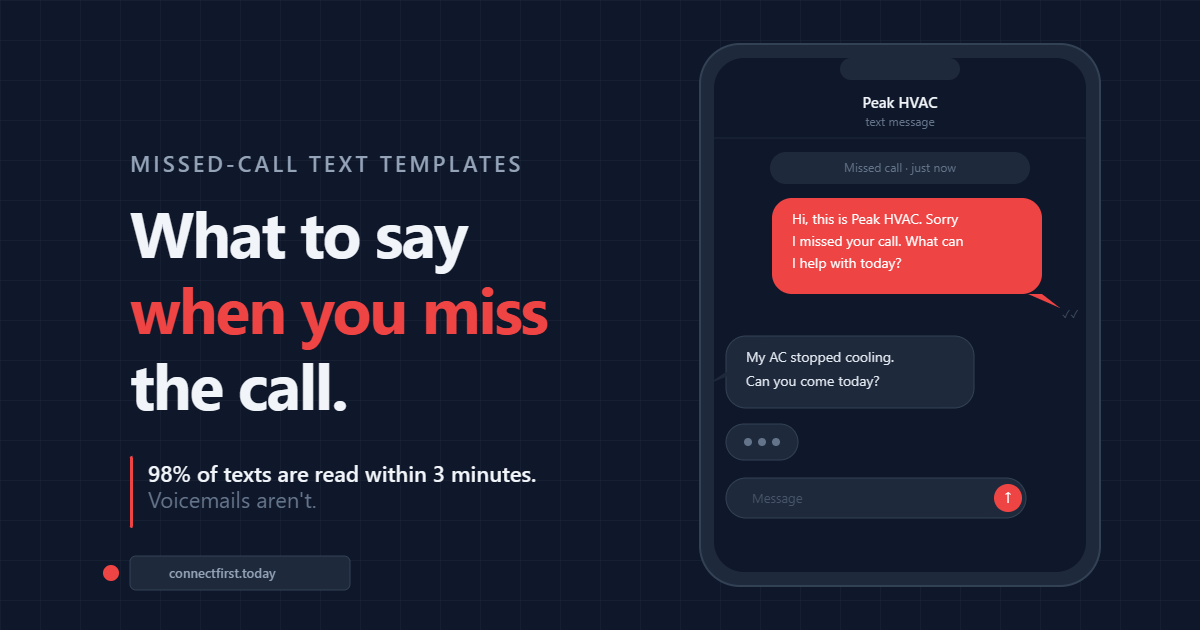
You're on a roof swapping a condenser fan motor. Your phone buzzes. You can't answer. The customer on the other end hears four rings, then voicemail, then hangs up. Thirty seconds later they get a text from your number.
That text is why they book with you instead of calling the next shop.
The text itself doesn't need to be clever. It needs to do one thing: make it feel like a person noticed the missed call and wants to help. The shops that lose this customer send texts that feel like receipts from an automated system, or they don't send anything at all.
In this article
What every good text has in common
Every effective missed-call text has three elements, roughly in this order: who sent it, that you saw the call, and one clear question.
Your name and company come first because the customer may not have your number saved. A text from an unknown number that jumps straight to "What can I help with?" looks like spam. One line of context changes everything.
The acknowledgment is short. "Sorry I missed your call" or "I saw your call" is all it takes. It confirms this text is connected to the call they just made.
The question at the end opens the conversation without narrowing it too early. "What can I help with?" works better than "Are you looking for AC repair?" because you don't always know why they called.
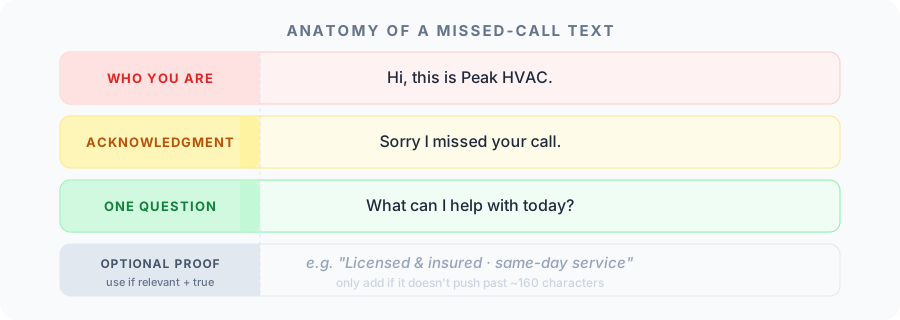
A fourth element shows up in some templates: proof. A license number, a warranty mention, "same-day service available." Use it when it's relevant and true, and when it won't push the text past roughly 160 characters. A 200-character missed-call text is still a text. A 500-character one starts to feel like a terms and conditions notice.
Template A: neutral and professional
Hi, this is Peak HVAC. Sorry I missed your call. What can I help with today?
Use this when you have no idea why they called (repair, replacement, new install, price check). It works at any hour and makes no assumptions. Most of the time, that's exactly what you want. Customers who get this text typically reply with what's wrong ("my AC stopped cooling") or when they want someone out ("can you come Thursday?"). From there, the conversation runs itself.
This is the one to start with. If you ever feel the need to overthink which template to use, just use this one.
Template B: after hours
Hi, this is Peak HVAC. I'm on a job but I saw your call. What's going on with your system?
"I'm on a job" does real work in that sentence. It signals you're busy and working, not unavailable or closed. Customers who call HVAC shops after 6pm are usually a little stressed. This text lets them know you're a real person, not a voicemail box. "What's going on with your system" fits better than "what can I help with" when someone might be dealing with a breakdown and just needs to tell someone about it.
Template C: peak season
Hi, this is Peak HVAC. Sorry I missed you. If your AC isn't cooling, tell me what you're seeing and I'll get you on the schedule.
July, heat advisory, phones ringing all day. You can't answer every call, and you already know what most of them are about. This template narrows the conversation without being dismissive. It's an invitation to give you the details you need to actually schedule them. If they're calling about something else (a quote, an annual tune-up), they'll just say that instead. No harm done.
Swap "AC" for "heat" in November and it works just as well for the other side of the year.
Template D: with a booking link
Hi, this is Peak HVAC. Sorry I missed you. Reply here with what you need, or book a time: [link]
This works, but only if the booking link is good. Test it on your own phone before you add it. If it loads in under three seconds, lands on a form with two fields, and doesn't require creating an account, use it. If it's a clunky third-party scheduler that takes four taps to find an open slot, leave the link out. A broken or slow booking experience does more damage than no link at all.
Template E: owner/tech voice
Hey, Logan with Peak HVAC here. Missed your call by a minute. What can I do for you?
For solo operators, this works because you are the brand. Using your first name makes the text feel like it came from the same person who'd show up at the door. "By a minute" is a small touch that implies you were just there, not that you ignored them for an hour before a system sent this. That detail earns more goodwill than it probably should.
What kills a missed-call text
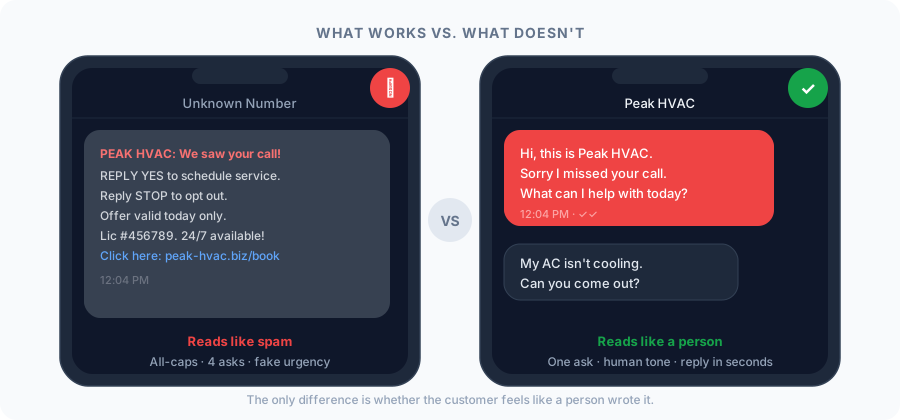
The texts that fail share a few characteristics.
The first is looking automated. All-caps, multiple exclamation points, "CLICK HERE TO SCHEDULE," "Reply STOP to opt out" tacked onto a message that isn't a promotional campaign — any of these tell the customer a machine sent this. Once they get that read, the conversation is over before it starts.
Here's a text that fails every test:
PEAK HVAC: We saw your call! REPLY YES to schedule service. Reply STOP to opt out. Offer valid today only. Lic #456789. 24/7 available! Click here: [link]
Seven sentences. Multiple asks. Fake urgency. A license number nobody asked for. That's a marketing blast wearing the costume of a missed-call reply.
The second is asking multiple things at once. "What can we help with? Give us your address and the best time to reach you!" forces the customer to figure out which question to answer first. They don't. They close the message and move on.
The third is over-explaining. A text that reads "Hi! We noticed you tried to reach Peak HVAC. We'd love to help! Please let us know how we can assist you today. We look forward to hearing from you!" was written by someone who has never sent a casual text in their life. The customer already knows why they called. They don't need a form letter before they can respond.
Short wins. Every time.
Send it within 60 seconds
The template matters, but timing matters more than most operators expect. A missed call at 2pm on a hot day usually means the customer is calling every shop in town at the same time. Speed-to-lead research consistently shows that response rates drop off fast after the first few minutes, and in HVAC during peak season, a few minutes might be all you have.
If your text goes out in under 60 seconds, you're almost certainly the first response they get. At five minutes, you're competing. At thirty minutes, most have already made a decision, whether that's booking someone else or deciding to just suffer through the heat until tomorrow.
This is why the message needs to be pre-written and automatic. Composing it in the moment while you're on a job means it either doesn't go out, goes out late, or goes out rushed. Use the free missed-call cost calculator to see what a slow response is actually costing you over a full season.
Test it before you rely on it
Call your tracking number from a different phone. Let it ring out. Wait for the text. Read it the way a stranger would, someone who's never heard of your company, called because their house is 85 degrees, and has four other tabs open with other HVAC shops.
If it sounds like something a neighbor would text you, it's working. If it sounds like a coupon mailer, rewrite it.
The whole point is to restart a conversation that got interrupted. Keep it short, keep it human, and get it out fast.
ConnectFirst sends your custom template automatically within seconds of a qualified missed call, from your existing business number, no new app required. See how it works