April in Chicago is a strange month for an HVAC shop. Heating calls have dried up. The AC rush hasn't started. Your techs are available, and your phone isn't ringing the way it was in January when everyone's furnace was acting up. If you run a 1-5 truck residential shop in Chicago, you already know this feeling.
Here's the problem: Chicago's first 90-degree day averages around June 8, according to the National Weather Service. That means you have roughly 8 weeks (mid-April through early June) to fill your schedule with spring tune-up bookings before the summer emergency calls take over. If you wait until May to start marketing, you've already burned half that window.
This guide is the spring marketing playbook for Chicago HVAC operators. Not generic national advice. Chicago-specific, built around this market's weather, housing stock, and the 1,800+ competitors you're up against.
The short version
- Chicago's spring marketing window typically lasts about eight weeks, from April to early June
- Less than 30% of your past customers will call to schedule a tune-up on their own
- Chicago's older housing stock (80,000 bungalows, thousands of greystone two-flats) creates a spring upsell opportunity most markets don't have: boiler shutdown + AC startup, one visit
- Maintenance agreements close at 25% when pitched in person. Every dollar in agreement value generates roughly two dollars in pull-through work
- The marketing spend is wasted if you miss the return calls while you're on a job
In this guide
- You Have 8 Weeks: Chicago's Spring HVAC Marketing Window
- Chicago's Double Service Opportunity: Boiler Shutdown + AC Startup
- The Invite-Back Campaign: Getting Past Customers on the Books
- Spring Tune-Up Pricing Strategy for Chicago
- Sell the Maintenance Agreement on Every Spring Call
- Don't Miss the Calls You Just Worked to Generate
You Have 8 Weeks: Chicago's Spring HVAC Marketing Window
Most of the US thinks of HVAC busy season as July and August. The data tells a different story: October is actually the busiest month for HVAC service calls nationally, driven by the first cold snaps that send everyone scrambling to check their heat. In Chicago, that pattern holds, but the spring shoulder season has its own dynamics.
Spring is the low point. After heating season winds down and before the first heat wave hits, call volume drops. Techs sit. And if you're not generating tune-up work right now, you'll hit July without the customer relationships and maintenance agreements that fill your summer calendar.
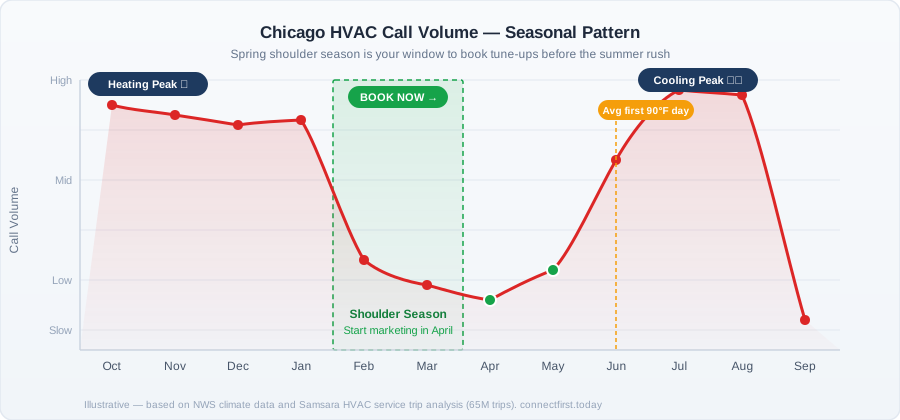
Chicago HVAC call volume follows a predictable seasonal pattern. The spring shoulder season (Apr–May) is the window to fill with tune-up bookings before summer emergency calls take over.
The window is short. Chicago's first 90-degree day averages June 8. Some years it's late May. The tune-up marketing push needs to happen now, in April, so you're booking jobs in late April and May. By early June, homeowners stop thinking about tune-ups and start thinking about why their AC isn't keeping up.
Start this week. Not next month.
Chicago's Double Service Opportunity: Boiler Shutdown + AC Startup
This is the part that most HVAC guides skip, because they're written for markets that run forced-air heat everywhere.
Chicago isn't that market.
Chicago was built during the peak steam heat era, roughly 1905 to 1940, which is exactly when 80,000 Chicago bungalows were constructed across the city. Add to that thousands of greystone two-flats, brick three-flats, and multi-unit buildings where a single boiler heats the whole stack. More than 75% of Chicago's multifamily housing predates 1942, and a huge portion of it still runs on the original hydronic or steam systems. Burnham and Weil-McLain boilers are everywhere if you service the city.
Spring in Chicago means shutting those systems down and starting AC up, often in the same visit.
That's an upsell you can make naturally, without it feeling like a pitch: "While we're shutting down your boiler and draining the system, let's check your AC before the heat hits. You don't want to find out in June that the coil is dirty."
The neighborhoods where this plays out every spring:
The Bungalow Belt is a crescent running from the northwest side down through the west side and around to the south. If you service any of these areas, you know the housing type: one-and-a-half-story brick, low-pitched roof, small yard, usually a boiler in the basement. On the northwest and west side: Portage Park, Belmont Cragin, Hermosa, Jefferson Park, Norwood Park. Southwest: Marquette Park, West Lawn, Gage Park, Brighton Park. South side: Bridgeport, Chatham, Auburn Gresham, Beverly, Morgan Park, Mount Greenwood.
The greystone corridors are a different story. These are multi-unit buildings where one boiler serves two or three floors: Lincoln Square, Logan Square, North Lawndale, Pilsen, Wicker Park, West Town/Ukrainian Village. A boiler failure here knocks out heat for the whole building at once, which makes these high-urgency, high-ticket calls. In spring they're also natural candidates for a shutdown-plus-AC-check combo.
Then there are the two-flat dense areas. South Lawndale (Little Village) and Brighton Park have roughly 70% of housing units in 2-to-4-unit buildings, the highest concentration in the city. One boiler, two or more families. Same double-service logic.
If your shop covers any of these neighborhoods, the spring combination call (boiler shutdown plus AC startup) is a real differentiator. Not many techs outside Chicago get trained on steam and hydronic systems. Own that.
The Invite-Back Campaign: Getting Past Customers on the Books
Less than 30% of customers will proactively schedule a tune-up. The rest wait until something breaks. If you want spring bookings, you have to reach out.
Operators call this an "invite-back" campaign. You're not cold-calling. You're reaching back to people who already trusted you with their home. That's a different conversation entirely.
Phone and Text Outreach
Your CRM or job history has the list. Start with customers you haven't heard from since last season. A short text works better than a voicemail for most people:
"Hi [Name], it's [Your Name] from [Shop Name]. We handled your [service] last year. Reaching out because AC season is coming up and we're booking spring tune-ups now. Reply here if you want to grab a slot, or call us at [number]."
Keep it short. Don't oversell. You're reminding them you exist and making it easy to say yes.
For customers you've had longer relationships with, a quick phone call works well: "Hey, it's [Name] from [Shop]. Just calling to make sure your AC is ready before the heat hits. We've got openings the next couple weeks."
That's the whole pitch. Don't overthink it. For a deeper look at text-based reactivation campaigns for past customers, see our HVAC slow season reactivation guide.
Google Business Profile Posts
GBP posts are free and take five minutes. During spring, post your availability with specific neighborhood callouts. Chicago has 77 community areas. People search locally, and naming their neighborhood signals you know the area.
Example post:
"Spring AC tune-ups and boiler shutdowns now scheduling in Portage Park, Jefferson Park, and Belmont Cragin. Slots go fast before Memorial Day. Message us to book!"
If you service Beverly or Morgan Park, name those. If you cover Wicker Park and Logan Square greystones, say so. It costs nothing and neighborhood specificity helps in local search.
Door Hangers in the Bungalow Belt
Low-tech, but it still works in the right neighborhoods. If your service area covers a few zip codes in the bungalow belt, hitting those blocks with a door hanger in April gets you in front of homeowners before they've thought about their AC.
The message should be simple: "Spring AC tune-up [price], [your phone/text number], [neighborhood coverage]." Don't make them read a brochure. One offer, one contact method.
The Historic Chicago Bungalow Association has over 16,000 members who are engaged, owner-occupied homeowners with older systems. That's the audience you're reaching when you work these neighborhoods. They own the home, they care about it, and they're more likely to invest in maintenance.
Spring Tune-Up Pricing Strategy for Chicago
Chicago AC tune-up pricing runs roughly $80 to $150, below the national average of $175 to $350. That's partly market competition (1,800+ contractors in the metro) and partly customer expectation shaped by years of loss-leader promotions.
The $49 special is everywhere in spring. Every shop does it at some point. My honest take: it only makes sense if you have a maintenance agreement pitch waiting on the other side of that visit. If you're doing $49 tune-ups without converting any of them to agreements, you're paying to keep your tech busy with low-margin work. The industry has pushed back on this for good reason. A thorough tune-up at $49 doesn't cover your cost.
Here's a structure that works better for a 1-5 truck Chicago shop. Standard spring tune-up: $99-$129 (the real service, not the discount version). Returning customers: $79-$89. Agreement sign-ups: $69 on the spot when they commit to an annual plan. You make it back and then some in pull-through work.
In a market with 1,800 competitors, you're not going to win on price. You win by being fast, reliable, and easy to deal with.
Sell the Maintenance Agreement on Every Spring Call
Spring is the best time of year to sell maintenance agreements. Homeowners have winter on their minds, their AC hasn't run yet, and they're in the mindset of "let's make sure everything's working."
Here's why it's worth building this into every visit.
Technicians who pitch agreements at the point of service close at about 25%, three times higher than follow-up sales calls. That means one in four customers you're standing in front of during a spring tune-up will say yes if you ask. Most shops don't ask.
Every dollar in maintenance agreement value generates roughly two dollars in additional pull-through work: repairs found during visits, parts replacements, system recommendations. Agreements don't just smooth out your shoulder season cash flow. They build the relationship that leads to the install call when the system finally gives out.
One language note that actually matters: call it an "agreement," not a "contract." Contractors who've tested this report that "contract" makes customers hesitate. Agreement implies a mutual, low-pressure arrangement. Contract implies fine print.
A simple spring pitch:
"While I'm here, we offer a maintenance plan that covers your AC tune-up in spring and furnace check in fall, priority scheduling when something breaks, and a discount on repairs. It's [price]/year. A lot of our customers in the neighborhood do it so they're not scrambling when something goes wrong in July. Want me to walk you through it?"
That's it. If they say no, you move on. If they say yes (and one in four will), you've built a recurring revenue relationship that pays you twice a year and fills your shoulder season calendar automatically next spring.
For more on how to use messaging to keep customers engaged between visits, see our HVAC slow season reactivation guide.
Don't Miss the Calls You Just Worked to Generate
You've texted your past customers. You've posted on GBP. You've put door hangers on bungalows in Portage Park. The calls start coming in.
And you're on a roof in Bridgeport.
This is where Chicago HVAC spring marketing breaks down for a lot of small shops. You spend time building demand, and then you can't capture it because you're in the field. According to one industry analysis, HVAC companies miss 27% of incoming calls, and that number climbs during busy periods when every tech is on a job.
The drop-off from a missed call is steep. 85% of callers who reach voicemail don't call back, and 62% contact a competitor instead. In a market where 1,800 shops are competing for the same spring tune-up bookings, the call that goes to voicemail is usually the call that goes to the next shop on Google.
43% of HVAC companies never return missed calls at all, which means just calling someone back puts you ahead of nearly half the market.
The fastest fix is automated text-back: when a call goes unanswered, the caller gets a text within 30 seconds acknowledging the miss and offering to help. It keeps the conversation alive before they dial someone else. If you want to see how that works for HVAC shops, read our breakdown of HVAC missed call text-back or why response speed matters more than most shops realize.
You did the work to generate the call. Don't let it go to a competitor because you were on a job.
Running spring tune-up campaigns and worried about missing calls while you're in the field?
ConnectFirst texts back missed callers in about 30 seconds from your existing business number, automatically. No new app. No answering service. Just a fast text that keeps the lead warm until you can call back.
See how it works →Key Takeaways
- Chicago's first 90-degree day averages June 8. Your spring marketing window is roughly 8 weeks starting in April. Don't wait until May.
- Chicago's pre-war housing stock (80,000+ bungalows, thousands of greystone two-flats) creates a natural upsell: boiler shutdown + AC startup in one visit. Own that if your competitors don't.
- Fewer than 30% of past customers will call you. Run invite-back campaigns — phone, text, GBP neighborhood posts, door hangers in the bungalow belt.
- Chicago tune-up pricing runs $80-$150. Use discounted rates as a door-opener for maintenance agreements, not as a standalone strategy.
- Pitch maintenance agreements on every spring visit. One in four customers will say yes at point of service. Call it an "agreement," not a "contract."
- Missed calls during your marketing push go straight to competitors. 85% of voicemail callers don't call back. Have a system for catching them.
ConnectFirst is missed-call text-back automation for small HVAC businesses. When a call goes unanswered, ConnectFirst texts the caller back in about 30 seconds from your existing business number, before they dial the next shop on the list. Learn more at connectfirst.today.